8 WNBA DFS Picks for 2026: Cash Games and GPP Tournaments
Explore 8 WNBA DFS Picks by role, salary and matchup, with cash game and GPP strategy. Projections are estimates; play responsibly.
You're close to lock, your favorite star fits, and an inexpensive starter has just become popular. Your cash lineup looks sensible. Your tournament lineup looks almost identical. The problem isn't necessarily the players. It's that you're asking the same roster to solve different problems.
Two lineups can contain the same star and still need opposite decisions. In a 50/50, you might accept heavy ownership to secure dependable minutes. In a large-field GPP, you might keep that star but change the surrounding players, target a correlated game environment, or avoid a popular replacement whose role is less secure than it looks.
The best WNBA DFS picks start with evidence about opportunity. Who handles the ball? Who gets the available rebounds? Who closes competitive games? A starting designation helps, but it doesn't answer those questions.
Choose the contest before choosing the player. A useful cash-game pick can be an unhelpful tournament differentiator.
Keep your DraftKings and FanDuel builds separate, too. Use the selected contest's scoring, salaries, eligibility, and editing rules rather than transferring a lineup idea unchanged between platforms.
The practical categories below connect each pick to its contest fit, its role evidence, and its main downside. None requires a prediction about tonight's hottest name. Each requires a check you can run before committing an entry, with projections treated as estimates rather than promises.
1. Core Plays for Cash Games With High-Usage WNBA Starters
Best fit: cash games. A core play combines dependable playing time with repeatable opportunities. Primary guards and wings often qualify because they initiate possessions, attempt shots, and create assists, but position alone doesn't establish a floor.
Look beyond scoring when choosing your foundation. For historical context, Basketball Reference's 2025 per-game leaderboard lists Napheesa Collier at 23.1 points, Angel Reese at 12.5 rebounds, and Alyssa Thomas at 9.4 assists per game as the respective category leaders.
Those are historical results, not current recommendations. They illustrate why a rebounder or facilitator can deserve core consideration even without the strongest scoring projection.
Test the floor behind the salary
Say you're comparing an expensive ball-handler with a cheaper starter. The expensive player projects better individually, but paying up forces a fragile bench option into another position. Compare the complete builds, not just the stars.
- Minutes security: Check expected playing time, rotation context, and whether the player normally closes.
- Opportunity mix: Prefer multiple credible paths to production over a projection dependent on unusually efficient shooting.
- Salary consequence: Inspect the weakest roster position after adding your core.
A floor projection isn't a guaranteed minimum. Foul trouble, injury, and an unexpected rotation can push any player below it.
Use a lineup-level floor target where available, but don't assume that adding individual floor estimates produces a reliable lineup floor. Shared game conditions matter.
Before-lock check: Sort projections by floor, inspect minutes and usage for your preferred core, then compare the full lineup against a cheaper-core alternative in the optimizer.
2. Value Options That Create Mid-Salary Lineup Flexibility
A cheaper player isn't automatically a value play. Useful value combines salary relief with a believable role. A modestly priced starter who handles the ball can be more valuable than a minimum-cost reserve who needs an unusual rotation to contribute.
Best fit: cash games when minutes are secure, GPPs when the ceiling justifies uncertainty. Injury replacements deserve particular scrutiny because starting and inheriting offensive responsibility aren't the same thing.
The salary constraint makes this distinction unavoidable. DraftKings' how-to-play guide describes a fictional $50,000 salary cap for salary-cap contests, so an individual player's projection must be evaluated alongside the roster that their salary allows.
Measure the opportunity change
Suppose a starting wing is unavailable. Her replacement enters the lineup, but the primary guard takes more shots and a reserve forward handles the closing minutes. The replacement's playing time may improve without a matching increase in usage.
Check which responsibilities move:
- Ball-handling: Does the replacement initiate possessions or mostly space the floor?
- Category volume: Are there additional shot attempts, rebound chances, or assist opportunities?
- Closing role: Will the player remain on the court when the game is competitive?
Points per dollar is a useful filter, not the final decision. It can exaggerate the appeal of a cheap player whose projection rests on uncertain minutes.
For a practical comparison, build a stars-and-value lineup and a balanced lineup. Keep the same contest assumptions, then inspect whether the salary savings improve the complete roster enough to justify the replacement's downside.
Before-lock check: Apply a minimum projected-minutes filter, compare salary value with role evidence, and rebuild without the popular value player to see what you're gaining.
3. GPP Upside Through Low-Owned High-Ceiling Plays
Low ownership isn't a reason to roster someone. It becomes useful when the player also has a credible route to a ceiling result.

Best fit: GPPs. Tournament upside candidates might include an overlooked scorer with secure minutes, a rebounder facing a favorable shot profile, or a secondary creator whose responsibilities expand under a plausible game script.
Start by describing the ceiling scenario in basketball terms. A player can benefit from extra possessions, increased ball-handling, or more closing minutes. Needing unusually hot shooting is also a scenario, but it's a more fragile one.
A tournament pivot should have a reason to succeed, not merely a reason other entrants might ignore it.
Compare ceiling with the cost of being different
Say your cash-oriented build includes a popular mid-salary scorer. A similarly priced forward projects slightly worse at the median but offers a stronger rebounding ceiling and lower ownership. That's a candidate worth testing, not an automatic upgrade.
Use the simulator to compare both versions against an appropriate modeled field. Examine strong finishes, duplication risk, and sensitivity to your assumptions rather than selecting whichever lineup wins a single simulation run.
Keep portfolio exposure deliberate. If the forward's ceiling depends on a questionable minutes increase, don't let the optimizer spread that assumption through nearly every entry.
You can also keep a dependable core and differentiate through a complementary role player. You don't need to replace every popular selection to create a distinct tournament lineup.
Before-lock check: Compare ceiling and projected ownership, test the candidate lineup against its safer alternative, and lower exposure if the upside disappears under a conservative minutes assumption.
4. Team Stacking for Correlated WNBA Lineups
A primary guard feeds a rolling post player. The post scores, and the guard receives an assist. That's a clear basketball reason to consider the pair together.
Best fit: GPPs, with selective use in cash games. Team stacking means rostering teammates whose opportunities can improve under the same game conditions. It doesn't mean every pair of teammates has positive statistical correlation.
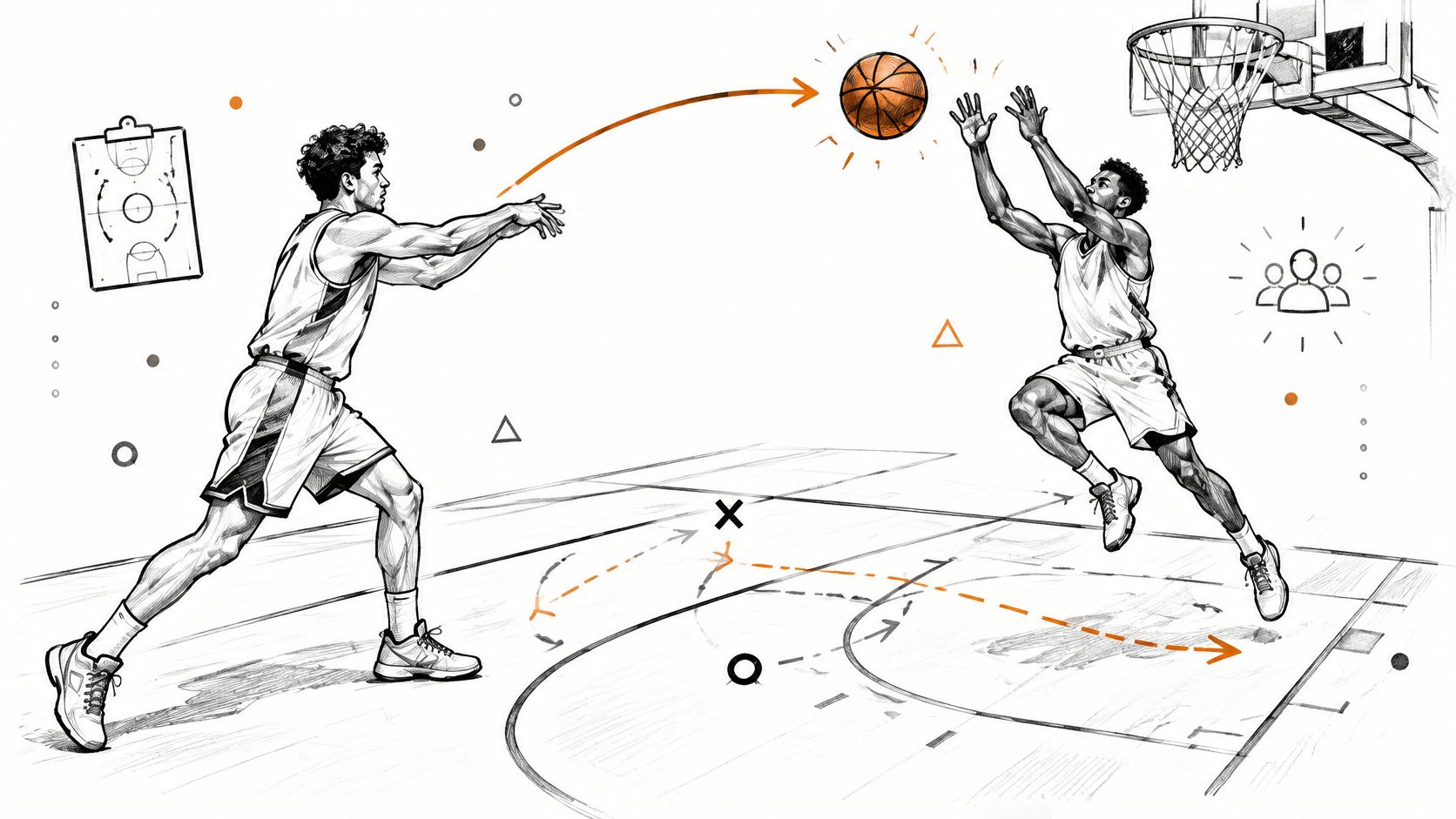
A faster, competitive game can support additional possessions and sustained starter minutes. But teammates can also compete for shots and rebounds. Your stack needs compatible roles, not just a shared uniform.
Build around an interaction
Start with a primary creator and ask who benefits from her successful possessions. A scoring forward, interior finisher, or perimeter shooter may fit, depending on how the offense operates.
- Assist connection: Look for a creator and scorer who share meaningful court time.
- Game environment: Compare projected pace, team scoring expectations, and competitive-game assumptions.
- Portfolio concentration: Limit repeated stacks so the same disappointing game doesn't undermine every entry.
For example, compare a guard-and-center pairing with a lineup that replaces the center with a similarly projected player from another team. The stacked version may have stronger joint upside, while the unstacked version may spread game-level risk.
An opposing player can also fit a game stack when both teams' production depends on a close, active game. Don't force the bring-back if its salary weakens the remaining roster.
Before-lock check: Set the intended stack in the optimizer, confirm overlapping minutes and complementary roles, then compare stacked and unstacked builds in the simulator.
5. Ownership Strategy for Finding Tournament Leverage
A popular player can be an excellent pick. The mistake is treating popularity as either proof of quality or a reason for an automatic fade.
Best fit: large-field GPPs. Projected ownership estimates how frequently the field will roster a player. Edge comes from making a competitive alternative that benefits when a popular construction falls short.
Player attention can concentrate sharply. Hard Rock Bet reported that games featuring Caitlin Clark generated 40% more overall betting handle than the league average in 2025.
That sportsbook figure doesn't measure DFS ownership. It's a reminder to verify contest-specific ownership rather than substitute television exposure or social-media attention for an estimate.
Find the basketball relationship
Suppose a cheap starter becomes popular after a teammate's absence. You believe another teammate will inherit more offensive responsibility. Rostering that teammate can offer a coherent alternative if the field overestimates the starter's usage.
However, both players might succeed together. Don't label every lower-owned teammate a direct counter play.
- Direct alternative: Compare players competing for the same salary allocation or positional slot.
- Role disagreement: Identify where your minutes or usage assessment differs from the field's likely assumption.
- Exposure discipline: Cap uncertain plays instead of turning a small disagreement into an all-in position.
In cash games, ownership generally deserves less weight than dependable opportunity and efficient construction. In GPPs, evaluate whether the lower-owned option gives up too much projection to justify its differentiation.
Review ownership after confirmed lineup news. An overlooked player can become obvious quickly, changing the decision without changing her basketball role.
Before-lock check: Refresh ownership, compare similar-salary alternatives, and inspect portfolio exposure to ensure your approach reflects a specific role-based disagreement.
6. Late Swap Strategy for Adjusting Picks Before Tip-Off
Best fit: late-swap rescue, with separate cash-game and GPP decisions. Late swap lets you edit eligible players whose games haven't started. It doesn't reopen a locked position because a player was unexpectedly inactive or disappointed.
DraftKings' contest rules explain that eligible late-swap changes must preserve salary and roster requirements, with players locking at their team's scheduled game start.
Don't assume every contest offers the same editing rights. DraftKings' late-swap support guide distinguishes eligible contests and identifies editable athletes with an open padlock.
Prepare replacements before you need them
Before the opening game, identify later alternatives at compatible positions and salaries. Preserve flexible roster slots for later players when the contest's eligibility rules allow it.
Say confirmed news reduces a late-game reserve's expected minutes. Instead of replacing her in isolation, rebuild the eligible portion of the lineup. A salary adjustment elsewhere may produce a better complete result.
- Preserve locked players: Treat their roster spots and salaries as fixed.
- Refresh assumptions: Update minutes, usage, and ownership before rebuilding.
- Protect construction: Check whether the replacement breaks a stack or creates excessive duplication.
In a cash lineup, prioritize the strongest remaining projection and dependable opportunity. In a GPP, consider how the lineup's position and remaining players affect the usefulness of a higher-variance alternative.
Don't chase a rumor, and don't assume an exported replacement has been submitted successfully. Review the actual contest entry after uploading.
Before-lock check: Confirm editing eligibility, rehearse a legal replacement in the optimizer, and verify that the rebuilt lineup preserves locked players, salary compliance, and intended correlations.
7. Props and Correlation for Informing DFS Decisions
A player can look attractive for an assists prop without being the best DFS selection at her salary. Sportsbook props and salary-cap DFS ask different questions.
Best fit: supplementary research for cash games and GPPs. A prop evaluates a statistical threshold at a particular price. A DFS lineup evaluates a player's combined production, salary, eligibility, and contribution to the complete roster.
Suppose your projected rebound distribution sits above a sportsbook's posted line. That disagreement deserves investigation. It doesn't establish that the player is underpriced on DraftKings or FanDuel.
Use disagreement to inspect assumptions
Check whether the model and sportsbook are using compatible expectations. A stale minutes assumption, uncertain availability, or different interpretation of the matchup can explain the gap.
- Projection timing: Confirm that the statistical distribution reflects the latest reliable role information.
- Market movement: Check whether the line changed after your original comparison.
- DFS translation: Apply the platform's scoring and salary before deciding whether the insight improves a lineup.
Don't assume the sportsbook is correct because it disagrees with your model. Don't assume your model is correct because it produces a precise probability.
Betting access also depends on location. The Congressional Research Service's sports-gambling overview explains that state restrictions differ, so verify local eligibility before wagering.
Keep betting and DFS budgets separate. Set limits, play responsibly and only where legal, and consult the responsible-play guidance before placing wagers.
Before-lock check: Compare the prop distribution with the underlying category projection, investigate any disagreement, and rerun the DFS lineup comparison without treating a prop lean as a roster lock.
8. Building a Complete WNBA Workflow With Projections and Simulations
A useful workflow keeps your assumptions consistent. If you edit a player's minutes, that change should inform lineup construction, contest testing, and any later rebuild.
Best fit: every contest format. Start with the slate and contest, establish your role assumptions, build candidates, test them, and preserve a record of the decisions made before lock.
StatWarrior is our recommended browser-based option for DraftKings and FanDuel. One subscription costs $29 per month and covers all 12 sports, including WNBA, with projections, lineup optimization, simulations, player props, and betting analytics.
Move through the tools in order
Use the tools to challenge a lineup rather than validate a favorite player:
- Set assumptions: Review floor, median, ceiling, salary value, and ownership in the DFS projections.
- Build alternatives: Use the DFS optimizer to apply player groups, stacks, exclusions, and exposure limits.
- Test the field: Compare candidates in WarriorSim. Warrior Edge compares player appearances in simulated top-one-percent entries with field ownership.
- Inspect market context: Use player props and sports-betting analytics as separate informational checks.
For example, build a cash candidate and a tournament candidate from the same projections. Keep the cash build focused on dependable opportunity, then test whether the tournament version gains meaningful upside through correlation and ownership choices.
Use the strategy articles and educational resources alongside free daily picks and the glossary when you need clarification. Afterward, compare retained pre-lock builds with graded results, separating a bad assumption from an unfavorable outcome.
Before-lock check: Confirm that projections, optimizer settings, and simulator inputs use the same slate assumptions, then inspect the exported lineup against the actual contest requirements.
How the eight WNBA DFS picks compare by contest fit, key metric and main risk
| Item | Best contest type | Key metric | Main risk |
|---|---|---|---|
| Core Plays: High-Usage WNBA Starters for Cash Games | Cash games, 50/50s, and double-ups | Projected floor and stable minutes | Foul trouble or blowouts can reduce playing time |
| Value Options: Mid-Salary Players Who Unlock Lineup Flexibility | Salary-cap builds and GPPs | Points per dollar and role certainty | Production may fall if minutes or opportunity change |
| GPP Upside: Low-Owned, High-Ceiling Plays for Tournaments | Large-field GPPs | Ceiling projection relative to projected ownership | Low-owned players may fail to deliver |
| Team Stacking: Building Correlated WNBA Lineups | GPPs | Team scoring environment and player correlation | A negative game script can hurt multiple players |
| Ownership Strategy: Using Projected Ownership to Find Leverage | Large-field GPPs | Projection advantage relative to projected ownership | Ownership estimates can be inaccurate |
| Late Swap Strategy: Adjusting Picks Before Tip-Off | Late-swap-eligible contests | Updated projections for unstarted roster spots | Unverified news can prompt poor swaps |
| Props and Correlation: Connecting Player Props to DFS Lineups | Player props and DFS lineup research | Projected stat distribution versus the prop line | Wagering risk and potential overexposure to a player |
| Building a Complete WNBA Workflow: One Platform for Projections, Lineups, and Simulations | Cash games and GPPs | Projections, lineup rules, simulations, and results review | Estimates can be wrong, and the subscription may not suit occasional players |
Turn These WNBA DFS Picks Into a Repeatable Process
The most useful WNBA DFS picks aren't a permanent list of players. They're decisions you can explain before the games begin. Start with the contest, identify the role evidence, and decide how much uncertainty the lineup can reasonably carry.
For cash games, prioritize dependable minutes, repeatable opportunities, and efficient salary allocation. Don't pay for a star's reputation if the remaining roster becomes fragile. A balanced build can be preferable when it removes a weak position without sacrificing too much projected production.
For GPPs, keep the basketball logic intact while considering the field. A lower-owned player needs a credible ceiling. A stack needs compatible roles. A fade needs more justification than discomfort with a large ownership estimate.
Record the assumption behind the pick
A short decision note makes results review more useful. Write down whether the pick depended on starting minutes, expanded usage, additional rebounds, or a favorable game environment.
- Role review: Did the player receive the opportunities you expected?
- Construction review: Did salary allocation or correlation create unnecessary weaknesses?
- Execution review: Were news, ownership, and contest rules checked before submission?
If the player received the expected minutes and opportunities but missed shots, don't automatically discard the process. If the player started but never handled the ball as projected, revise the role assumption. The box score alone won't distinguish those situations.
Keep model uncertainty visible, too. A narrow difference between candidates can disappear when you make a reasonable minutes adjustment. When a lineup only looks attractive under an aggressive assumption, reduce exposure or choose a more reliable alternative.
Make late decisions deliberately
Prepare legal alternatives before the slate starts. Use late swap only when the contest allows it, preserve locked players, and react to confirmed information rather than speculation. Review the submitted entry after any upload.
Maintain a fixed entertainment budget and avoid increasing entries to recover losses. Keep sportsbook decisions separate from DFS construction, and play responsibly and only where legal.
A repeatable process won't eliminate variance. It will help you identify which decisions were supported, which assumptions failed, and what to change next time. Before entering a lineup, be able to state its contest fit, its strongest role evidence, and its biggest risk in plain language.
StatWarrior offers WNBA projections, lineup optimization, and contest simulations to help you compare cash-game builds and GPP alternatives. Visit StatWarrior to review a slate, test your role assumptions, and evaluate candidate lineups before lock, remembering that every output is an estimate, not a guarantee.
Made with the Outrank app