Best Football Fantasy Sites for DFS and Season-Long Play
Compare the best football fantasy sites for DFS, season-long leagues, and free play. See key features, research tools, and who each platform suits.

Two players sit down for the same kickoff window. One runs a twelve-team redraft league with a group chat that never sleeps, and needs a free host with a live draft board, keeper rules, and waiver settings a commissioner can easily find. The other is building 150 lineups that differ enough in structure to compete in a large GPP, and needs projections with floor and ceiling ranges, ownership estimates, and a CSV that uploads cleanly to DraftKings or FanDuel.
Both of them type best football fantasy sites into a search bar. Almost every list they find ranks the same platforms by traffic and brand recognition, which answers neither question.
The tool that suits a commissioner is usually a bad fit for someone managing player exposure across dozens of tournament entries, and no optimizer will draft your league. That's the sorting principle here: each platform below is graded on the job it does, the numbers it produces, and what it can't promise you.
Prices and plan tiers move, so confirm current terms at checkout before you commit. Everything a projection or simulation outputs is an estimate.
1. StatWarrior
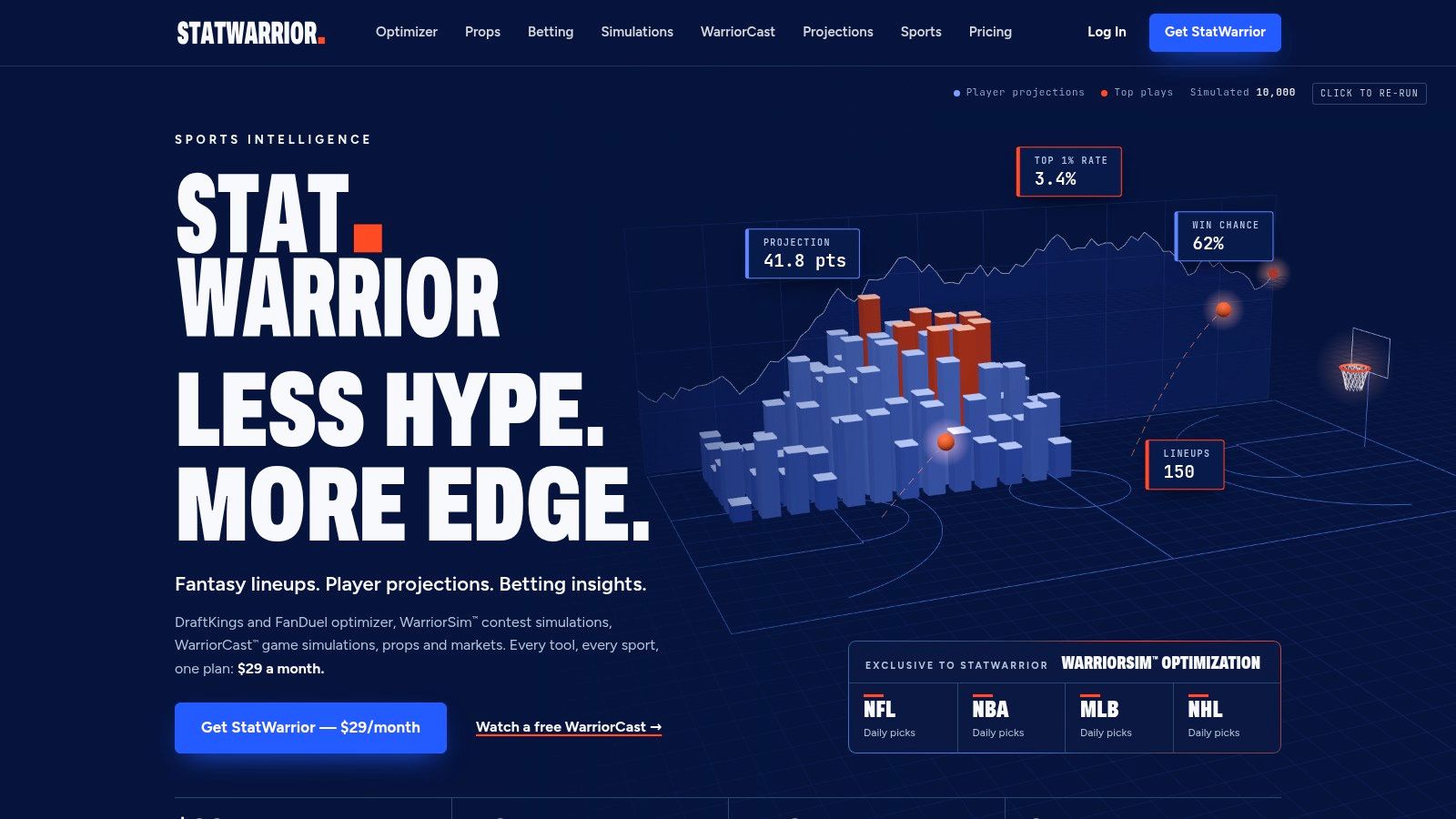
StatWarrior is the pick if you play DraftKings or FanDuel and want lineup building, projections, contest simulations, props, and betting markets under one login instead of four. It runs in the browser at statwarrior.com, builds under each site's salary cap and roster rules, and exports CSVs in the upload format both platforms accept. One subscription covers 12 sports at $29 a month, with no feature tiers and cancellation through account billing.
What the optimizer actually produces
The optimizer builds up to 150 lineups per build using salary limits, roster requirements, locks, exclusions, exposure caps, team stacks, player groups, and correlation rules. Every projection carries a floor, median, and ceiling from an outcome distribution, with projected ownership and salary value beside it. Those numbers are editable, and you can upload your own or blend sources at specified weights when you disagree with the model.
What separates it from a rankings site: WarriorSim draws correlated outcomes for every player, scores candidate lineups against a modeled contest field built entry by entry under the real salary cap, and grades them against the payout structure. Warrior Edge reports the share of simulated top-one-percent entries a player appears on minus the share of the field projected to roster him.
Late swap rebuilds unstarted positions while holding locked players, which matters when a starting lineup is announced an hour before lock. WarriorCast runs 10,000 simulations of NFL, NBA, and NHL games and updates hourly as injury reports and starting goalies change. The props tool shows the sportsbook line, the projection, the gap, and over and under probabilities from the simulated distribution. Betting analytics compare moneylines, spreads, totals, and alternate lines across eight sportsbooks.
Portfolio controls: exposure caps, locks, stacks, and correlation rules let 150 builds differ in structure, not just in one player swap.
Contest-aware modeling: simulations run against a salary-constrained field and payout structure, on simulations separate from the ones used to build the lineups.
Clean handoff: CSV export in each site's format, with a late swap file you can upload as news breaks.
One price: projections, props, simulations, and market comparisons aren't sold as separate products.
Everything is an estimate: projections, probabilities, and simulated results can be wrong, and lost lineups or bets aren't refunded.
Priced for volume: $29 a month is more than a single-entry casual player needs, and the platform takes no wagers or contest entries.
No awards or testimonials on the page: the published track record and graded results are performance information, not a guarantee.
2. FantasyPros
FantasyPros is where most season-long managers should start, because it handles the unglamorous weekly work: consensus rankings, start/sit calls, waiver targets, and trade analysis, synced to your actual roster. Free tools cover a fair amount of that, and the deeper features sit behind a subscription.
The category is big enough to support this kind of specialization. Grand View Research estimated the global fantasy-sports market at approximately USD 27.8 billion in 2025, with projections reaching USD 75.1 billion by 2033 at a 13.3% compound annual growth rate, and football/soccer as the largest sport category at 21.1% of 2025 revenue. Market sizing varies widely between firms because definitions differ, so read those numbers as direction, not gospel.
Consensus over conviction: averaging many analysts smooths out one loud outlier, which is usually what you want on a Tuesday waiver decision.
League sync: connecting your league lets recommendations account for who you roster instead of who ranks highest overall.
Weekly coverage: start/sit, waiver, and trade tools map onto the three decisions that decide most head-to-head matchups.
Paywall sits in the middle: plenty of the useful weekly tools are subscription-only, and the free tier thins out fast in season.
Consensus isn't a strategy: it tells you what the market thinks, not how to construct a tournament portfolio.
When you need a head-to-head call across sports, a player comparison tool beats reading four sets of rankings side by side.
3. SaberSim
SaberSim sells a range of outcomes instead of one number per player, which is the right instinct for tournament play. Its NFL optimizer and range-of-outcomes projections let you ask what a lineup returns when a receiver draws ten targets instead of six, and contest simulations on the higher tiers push that question into field context.
The trade-off nobody prints on the pricing page: a simulation you can't interpret is a random number generator with extra steps. If you can't explain why a build wins at the 80th percentile, the tool hasn't taught you anything yet.
Plan structure matters here. Advanced features sit on expensive tiers and lineup pool limits change by plan, so a small bankroll gets the projections and the optimizer but not the full simulation stack. Budget for the tier that matches your entry volume, not the one that looks complete in a comparison chart.
Expect a week of learning correlation, stacking, and duplicate-lineup rules before the tool pays you back. That's normal. The same range-based thinking travels across sports, and these NBA DFS player projections show how a distribution becomes a usable number.
Where it wins. NFL lineup building for DraftKings, a simulation-first view of outcomes, paid plans that bundle learning resources and community access, and multi-sport coverage.
Where it doesn't. The features most worth having are gated behind expensive tiers, and nothing here promises a payout.
4. FantasyLabs
FantasyLabs is for the player who wants to bend the model rather than accept it. You can adjust player projections, set stacking and correlation rules, cap exposure, and generate up to 150 lineups per build, then export to DraftKings or FanDuel. The controls are the point: a portfolio of tournament lineups is a set of correlated bets, and the tool lets you shape those correlations directly.
The format it serves grew fast. FanDuel entered the market in 2009 and DraftKings launched in Boston in 2012, and one industry estimate put fantasy-sports participation at 41.5 million people in 2014 rising to 56.8 million in 2015, with daily fantasy alone going from 1.2 million users in 2014 to 3.9 million by the end of 2015 (Business Insider). More entrants means softer fields in some contests and much sharper ones in others, which is exactly why exposure control earns its keep.
Model flexibility: adjust projections to your own assumptions instead of accepting a single house number.
Portfolio mechanics: stacking, correlation, and exposure settings built for multi-entry work rather than one-off lineups.
Export path: lineups leave cleanly for both major sites.
Context: strategy articles sit next to the data tools instead of in a separate content silo.
Learning curve: customization only helps once you know which knob to turn.
Verify pricing: package details and current tiers should be confirmed on the site before you commit.
5. RotoGrinders
RotoGrinders bundles the LineupHQ optimizer, projections, ownership data, and SimLabs simulations with written strategy, which is a different bet than selling tools alone. The NFL package costs more than a multi-sport plan, so it needs to replace something in your stack rather than add to it.
Read that cost against your entry volume. A Sunday workflow has to return the subscription in time saved and in mistakes avoided: ownership numbers you'd otherwise guess at, simulation output you'd otherwise skip entirely. If you play a handful of cash lineups a week, a broader multi-sport subscription covers more ground for the money. Heavy GPP players get the most from the pairing, since LineupHQ handles construction while SimLabs tests lineups against a projected field before lock.
Jurisdiction is the filter most rankings skip. Sports betting is legal in 38 U.S. states plus Washington, D.C., and Puerto Rico, and several states have enacted privacy laws giving consumers stronger rights over data collection and use (AFS Law). North America is the largest fantasy-football market, but legal access still depends on where you live. Check your state regulator before you deposit anywhere, and play only where it's legal.
Where it wins. Tools and strategy from one provider, an optimizer and simulation workflow in the same account, and an NFL package with clearly specified features.
Where it doesn't. NFL DFS access requires the paid subscription, and a football-only package is poor value if you also play basketball or baseball.
6. Stokastic
Stokastic's pitch is field awareness. Projections and ownership estimates are table stakes now; what people pay for is contest simulation and late swap, the two things that answer the questions deciding a GPP night. Does this lineup beat the field, and what happens when a starter is ruled out forty minutes before lock?
Short-horizon play drives that demand. In North America, daily and weekly fantasy plus ancillary products accounted for 60.55% of fantasy-sports revenue in 2025, and American football represented 58.25% of the regional market by sport value (Mordor Intelligence). Late swap isn't a luxury in that environment. It's the difference between a live lineup and a zero.
Package sizes vary by lineup volume, and premium NFL tiers get expensive quickly. Compare the tier against the number of entries you'll realistically build on a Sunday, then compare it against a multi-sport plan.
Tournament lens: lineups get evaluated against a modeled field, not in isolation.
Late swap: rebuild the positions that haven't started while everything else stays locked.
Slate analysis: written breakdowns explain the approach, which shortens the learning curve.
Volume tiers: package sizes scale with how many lineups you build.
Cost: premium NFL packages run high for a single-sport product.
Tier spread: features and lineup limits differ by plan, so read the fine print.
The build, export, and swap loop isn't football-specific. A WNBA lineup optimizer uses the same steps once the summer slate opens.
7. Fantasy Life
Fantasy Life is a season-long product with a DFS and betting layer attached. Rankings, projections, mock drafts, start/sit help, and waiver guidance form the core. Best-ball and DFS resources, a game model, and a player prop finder sit on top. League syncing personalizes some of that advice to your rosters, so start/sit calls reflect your lineup rather than a generic one.
That setup fits the season-long manager who wants prop angles without paying for a second subscription. It gets thinner once you need contest simulation or multi-entry construction, because the DFS tools support research rather than lineup building at volume.
In a 2024 survey of 500 U.S. fantasy-football users aged 18 to 45 by IBM and Morning Consult, nearly 90% said they regularly used at least one AI or AI-related tool for fantasy football (IBM). With generated advice this common, the useful question is what a tool measures and whether it hands you a range or a single confident number. Either way, projections stay estimates. A projection is a starting point for your own call, never a guarantee of output.
Where it wins. One subscription covering season-long, DFS research, and props, with a free tier that lets you test the workflow before paying.
Where it doesn't. The DFS side is broader than it is deep. It won't replace a dedicated optimizer for tournament volume, and FantasyLife+ gates a meaningful slice of the content.
8. Sleeper
Sleeper is a league host, not a DFS tool, and keeping that straight saves money. Redraft, keeper, and dynasty formats, custom scoring, commissioner controls, auction drafts, several waiver systems, and built-in chat cover what a commissioner needs. Core football league hosting is listed as free and ad-free.
The audience supports both kinds of product. Industry estimates put U.S. fantasy participation at roughly 60 million people, with the 18 to 34 group the most active segment, and ESPN reportedly retained 48% of fantasy-football monthly active users while Sleeper, PrizePicks, and Underdog posted double-digit growth from August 2023 to August 2025, against single-digit gains for FanDuel and DraftKings (Growth Market Reports).
Commissioner test: if your league trades future rookie picks and argues about waiver priority in February, you need dynasty support and configurable waivers. If you run a ten-team redraft where three people forget to set lineups, the extra machinery just adds noise.
Free hosting: substantial customization without a subscription, which matters for a league of twelve.
Dynasty depth: future-pick trading and taxi mechanics that generic hosts handle badly.
Built-in chat: league activity lives in the same app as the roster.
Not a DFS tool: no optimizer, no contest simulation, no ownership model.
Feature load: the interface can overwhelm a simple redraft group that just wants a draft board.
9. ESPN Fantasy Football
ESPN is where a lot of people start, and the history explains why the format feels familiar. The first widely recognized fantasy football league was formed in 1963, when Bill Winkenbach and colleagues created the Greater Oakland Professional Pigskin Prognosticators League, drafting NFL players and scoring teams on real-game performance (Fantasy Football and the First Fifty Years). Participation reached approximately 12.8 million unique fantasy-football users in 2006 and about 36 million by 2012.
Free public leagues solve the hardest problem for a new player, which is finding eleven other people. League Manager settings give a commissioner room to customize scoring and roster rules for a private group, and mock drafts, live scoring, and transactions work as expected on day one.
Where it wins. Free core play, public leagues for solo players, and a mainstream experience that requires no onboarding.
Where it doesn't. Standard public leagues use preset rules with little room to negotiate, and it's a league platform rather than a DFS analytics product. You won't find ownership models or contest simulation here.
10. Yahoo Fantasy Football
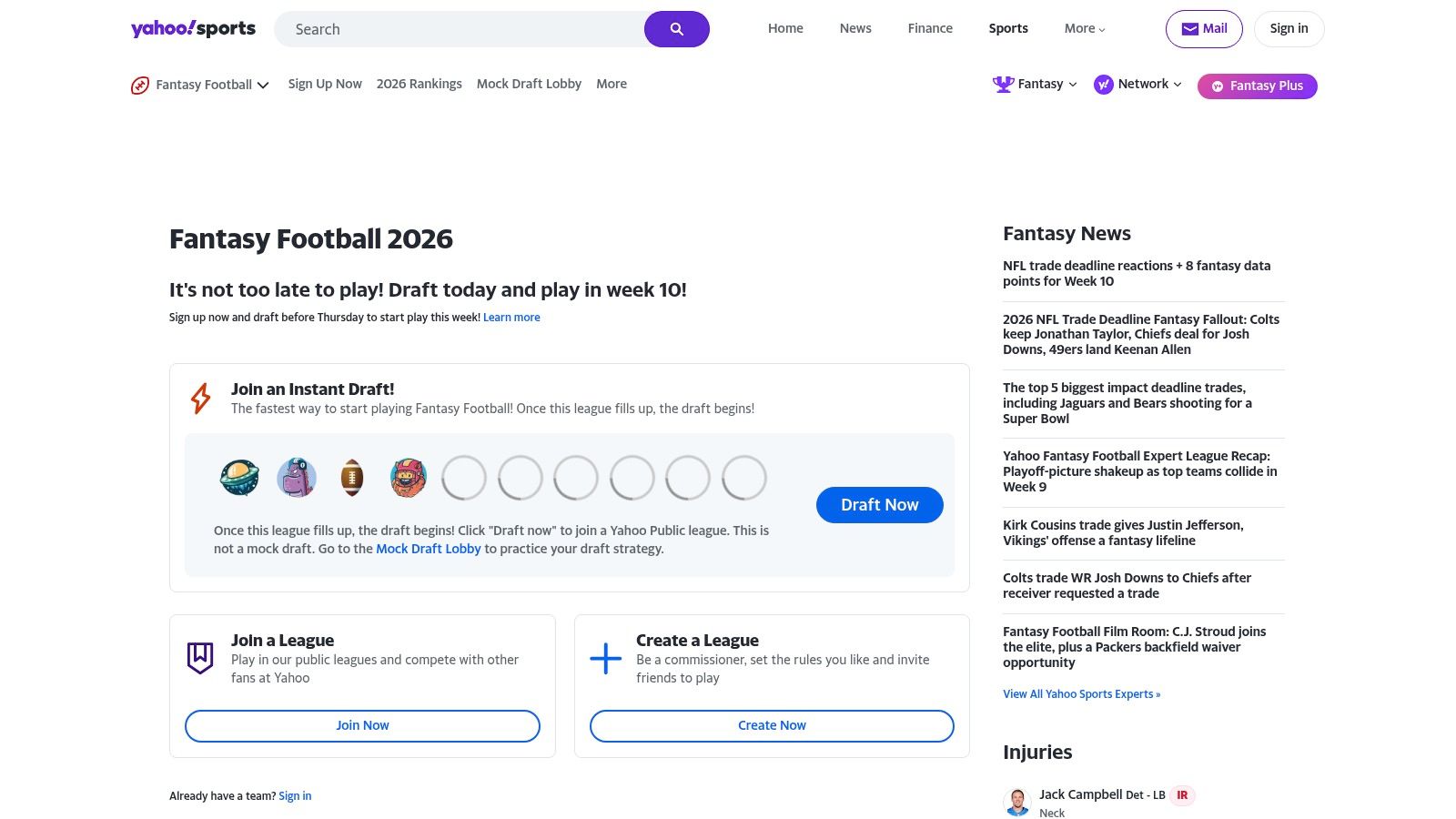
Yahoo offers the same free entry point as ESPN with one structural difference. Beyond free public and private leagues, it lists public prize leagues with entry fees where available, so a single app can serve both a casual group and a player who wants something on the line.
Football's share of the market explains why these hosts keep investing in the format. Straits Research put the football segment at 42.8% of the global fantasy-sports market in 2025 (Straits Research).
Free public leagues: a solo player can join a group without recruiting one.
Commissioner control: private leagues expose custom settings that public ones don't.
League types: free and entry-fee options in the same account.
Fixed defaults: public leagues run preset rules you can't change.
Prize leagues cost money: they're a different product from free hosting, and they carry their own terms.
No DFS analytics: it's a place to play, not a place to model ownership or simulate a slate.
How the Best Football Fantasy Sites Compare on Core Features
The table sorts each platform by the player it serves. The first group builds DFS lineups, the second handles season-long research, and the third hosts leagues. That split matters more than any single feature, because a league host will never produce a CSV upload and a DFS optimizer will never run your waiver wire.
| Item | Primary Focus | Best For | Cost Model | DFS Optimizer |
|---|---|---|---|---|
| StatWarrior | DFS analytics, simulations, and betting-market analysis | Players seeking multi-sport tools and contest-focused lineup analysis | $29 per month; all features included | Yes; up to 150 lineups with exposure, stacking, and correlation controls |
| FantasyPros | Season-long fantasy research and team management | Managers who want personalized rankings, roster advice, and draft tools | Free tools; subscription for advanced features | No dedicated DFS optimizer; DFS research and advice only |
| SaberSim | DFS optimization and simulation-based analytics | Players seeking range-of-outcomes projections and contest analysis | Paid plans; advanced features on higher tiers | Yes; optimizer with simulations and plan-dependent lineup limits |
| FantasyLabs | DFS data, projections, and lineup building | Players who want customizable models and tournament lineup controls | Paid subscription with tiered packages | Yes; up to 150 lineups with stacking, correlation, and exposure controls |
| RotoGrinders | NFL DFS tools and strategy content | NFL players seeking an optimizer alongside expert coverage | Paid; listed NFL product is $74.99 per month | Yes; LineupHQ and simulation-driven SimLabs |
| Stokastic | NFL DFS projections, ownership, and contest analysis | Tournament players seeking simulations and lineup tools | Paid packages; features and lineup limits vary by tier | Yes; optimizer with contest simulations and late-swap tools |
| Fantasy Life | Season-long fantasy tools, DFS, and betting research | Managers seeking broad fantasy guidance and some DFS resources | Some free tools; paid FantasyLife+ tiers | No dedicated DFS optimizer; DFS research and advice only |
| Sleeper | Fantasy league hosting and management | Redraft, keeper, and dynasty leagues with customization | Core league hosting is free and ad-free | No; league platform, not a DFS optimizer |
| ESPN Fantasy Football | Fantasy football league hosting | Free public or private leagues and standard league management | Free core league play | No; league platform, not a specialist DFS optimizer |
| Yahoo Fantasy Football | Fantasy football league hosting | Free public leagues or private leagues with custom settings | Free leagues; some prize leagues require entry fees | No; league platform, not a specialist DFS optimizer |
Read the cost column carefully, because the pricing gates differ in kind. League hosts are free because hosting is the product. Research tools like FantasyPros and Fantasy Life put advice behind a subscription while leaving basic features open. The DFS platforms charge the most, and several split their lineups, simulations, and late-swap functions across tiers, so the headline price may not include the feature you need.
StatWarrior is the exception on structure: one $29 monthly plan covers all twelve sports and every tool, with no feature tiers. Two details are worth knowing before paying for any of these subscriptions. StatWarrior's projections and simulations are labeled estimates, results are never guaranteed, and lost lineups or bets are not refunded. Its prices also exclude sales tax, VAT, or GST, with any required tax calculated before payment. Every paid DFS tool on this list sells modeled probabilities, and none of them can promise a return on your entry fees.
Matching Your Platform to Your Game Plan
Start with the job you need done, not with the brand you recognize.
If you run a league, your requirements are hosting and commissioner controls. Sleeper covers dynasty and future-pick trading, ESPN and Yahoo cover free public and private leagues with the lowest onboarding friction, and FantasyPros or Fantasy Life handle the weekly start/sit and waiver decisions once the season starts. None of those subscriptions will help you build a tournament portfolio.
If you play DFS on DraftKings or FanDuel, grade each tool on five things. First, whether projections arrive as a range with a floor and ceiling or as one confident number. Second, where ownership comes from, since a field model and a public consensus produce very different strategic advantages. Third, whether contest simulation exists and whether it accounts for payout structure. Fourth, how late swap behaves when news lands after you've built. Fifth, whether the export uploads without hand-editing, because a hundred lineup edits at 12:55 is how you lose money to the clock rather than the field.
Then match price to volume. A $74.99 football-only package is reasonable for someone building dozens of tournament entries a week and expensive for someone playing two cash lineups on Sunday. A $29 multi-sport plan covers more ground, so compare the total cost of the tools you open rather than the headline tier.
Two habits keep the rest honest. Set your bankroll limit before you build, and treat every projection, ownership estimate, and simulation as an estimate that can be wrong. No platform, including the ones above, guarantees a result, and lost entries aren't refunded.
One more filter: confirm the contest type is legal in your state before you deposit, and read what data a platform collects before you sync an account. Play responsibly and only where it's legal, and check the responsible play guidelines for the ground rules.
The best football fantasy sites for you are the ones that answer your specific question, on the slate you play, at a price your bankroll can justify.
If you want the projection ranges, the ownership model, and the contest simulation inside the same tool you export from, StatWarrior covers all 12 sports on one $29 monthly subscription with no feature tiers. Build a single Sunday slate, run the lineups against a modeled field, and compare the results with what you'd have played by hand. Start at StatWarrior and see how your builds hold up.