WNBA Lineup Optimizer Explained: How It Works
Learn how a WNBA lineup optimizer uses projections, salary caps, roster rules and exposure controls to build lineups for DFS contests.
You're an hour from lock on a DraftKings or FanDuel WNBA slate. A starter is questionable, your salary is nearly spent, and the backup's single projected score looks ordinary. The usual habit is a flat bump of a few fantasy points. That habit misses the main shift: minutes, rebounds, assists, and steals move together, and the new roster still has to pass every site rule.
A WNBA lineup optimizer searches legal combinations instead of guessing at a good roster. Projections, simulations, and picks are estimates, not promises of profit. Play only where daily fantasy is legal, and keep the spend inside a budget you already chose.
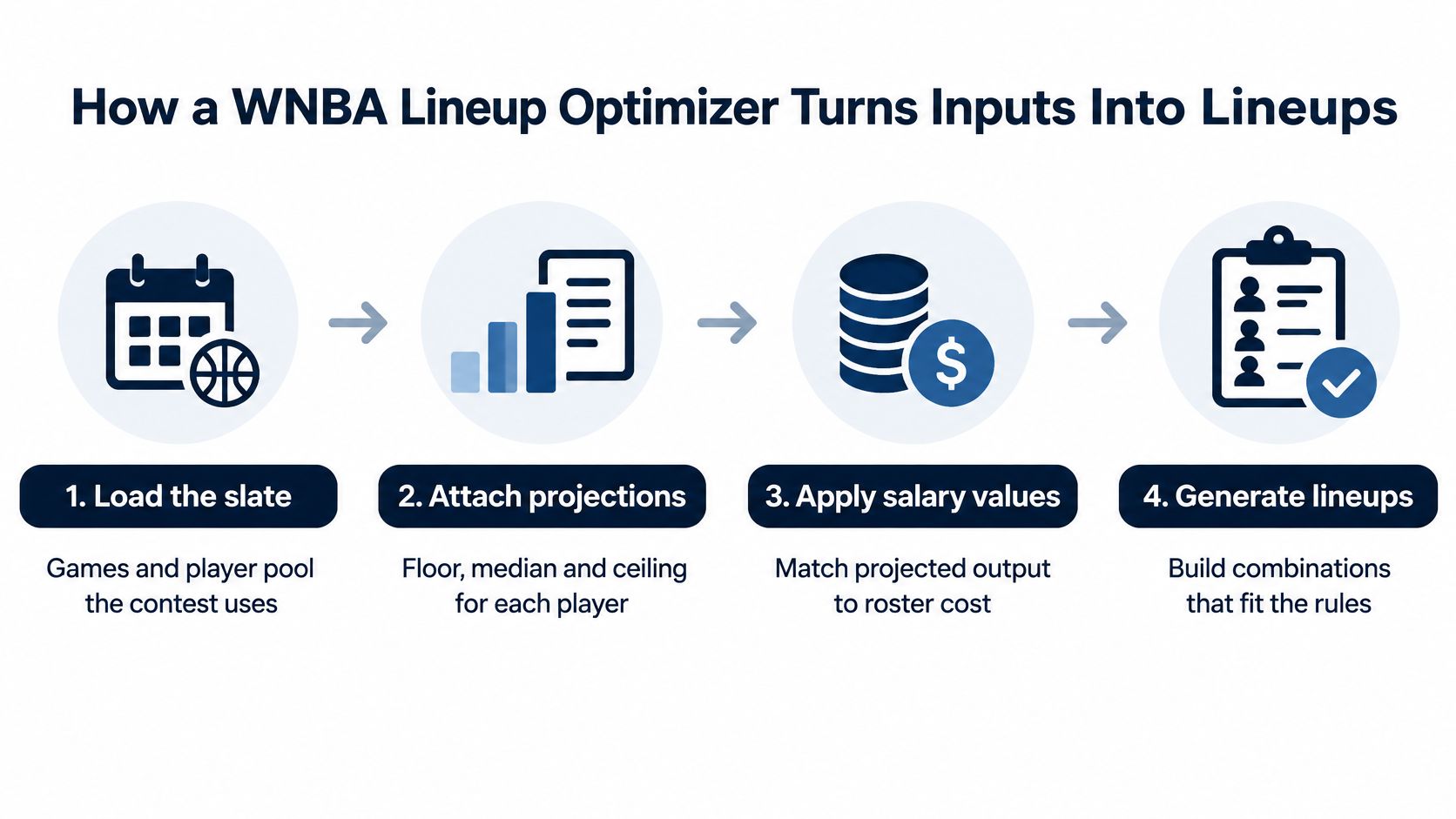
How a WNBA Lineup Optimizer Turns Inputs Into Lineups
Build the slate in the same order every time, so a late edit has a clean place to land.
- Load the slate. Pull the games and the player pool the contest uses. A player from tomorrow's card doesn't belong in tonight's file.
- Attach projections. Give each player a floor, a median, and a ceiling. One average hides whether the score is steady or a boom-or-bust outcome.
- Apply salary values. Match those figures to the salary and the roster slots on that site's WNBA format, including flex spots.
- Set controls. Add exposure limits, team or game stacks, and a lock or exclude list before the search starts.
- Search under one objective. Keep only lineups that satisfy every rule, then rank what remains.
- Export and review. Download the site's upload file and read it before you submit. A clean file can still hold a player you no longer want.
What the search is doing
The solver doesn't invent a clever lineup. It checks large numbers of combinations and throws out any that break a rule, the way a travel planner rejects an itinerary that misses a connection. Speed is the point. You couldn't hand-check that many salary-legal groups before tip-off.
Cash games and GPP contests don't share an objective. Cash builds push expected points, because a steady floor is what you need to clear the cash line. Tournament builds also weigh ceiling and projected ownership, because a slightly lower median can reach the top payout region more often when the field is large.
Run two checks before you trust any file. The player pool has to match the current slate, and the projection timestamp has to be recent enough to reflect the latest news.
If either check fails, stop. Rebuilding on a stale pool just prints yesterday's opinion in a new CSV.
Salary Caps and Roster Rules the Solver Enforces
Say your favorite high-projection wing fits the narrative and blows the salary cap by a small amount. That lineup is gone, no matter how strong the median looks. The solver treats the cap as a wall, not a preference.
A projection-only ranking creates the same trap in a quieter way. The top eight names can each look excellent and still be unable to share one legal roster, because their salaries, positions, or team counts can't coexist. Ranking never asks that question. The solver asks it before it keeps a lineup.
| Constraint | What the Solver Checks | What Breaks If Ignored |
|---|---|---|
| Salary cap | Total salary of all selected players stays under the contest cap | Lineup is rejected at upload |
| Roster slots | Each required position and flex slot is filled by an eligible player | Upload fails or the lineup is incomplete |
| Player pool | Only players listed on the selected slate are considered | Scratched or unlisted players stay in the build |
| Team limits | Team counts meet the site's rules for the contest format | Lineup fails validation or stacks become invalid |
| Exposure caps | Each player's share of lineups stays under a set maximum | The portfolio overloads on one projection |
| Lineup uniqueness | Entries differ from each other by a set number of players | Near-duplicate lineups waste entries |
Slot counts and cap amounts come from the site's current WNBA contest format. They aren't the same on every slate or between DraftKings and FanDuel, so memory is a bad source. Open the contest and read the format before you type settings.
Pre-build checklist
- Slate type: Confirm cash or tournament, because the objective changes with it.
- Cap: Type the figure shown on this contest, not last week's.
- Roster slots: Match every position and flex slot to the format.
- Late swap: Note whether this contest allows edits after lock.
Enter that rule set, generate one lineup, and confirm it passes every check. Only then build the full set. A bad rule on lineup one is a bad rule on all 150.
Projections, Floors and Ceilings Feeding the Model
Projections are the raw material, and the model reads each one as a recipe rather than a single number. Expected minutes, usage, shooting efficiency, rebounds, assists, steals, blocks and turnovers get converted into fantasy points under that site's scoring. Two players can reach the same average through completely different categories.
A guard whose value is mostly assists can post a useful fantasy score on a quiet shooting night. A forward whose value is mostly rebounds can do the same with almost no playmaking. One blended average describes neither path, so a side-by-side read of box-score categories makes each player's value profile easier to see before you lock a build. An NBA player comparison shows what that category-by-category view looks like.
A high-usage star sets the scale. In 2024, A'ja Wilson led the WNBA with an average of 26.9 points per game across 38 games, the figure published on Basketball-Reference's 2024 totals. That scoring load is a benchmark for what a star's median looks like. A role player who inherits a few extra minutes gets a much smaller adjustment, not a copy of that ceiling.
Floor, median, and ceiling
Floor is the low end you still consider plausible. Median is the middle of the distribution. Ceiling is the upper outcome you care about in large fields. A 20-point projection with a wide range behaves differently from a steady 20 with a narrow range. In a tournament, the wide range can be the better hold if its ceiling reaches the payout region. In a cash game, the narrow range is usually the one you want, because a collapse is expensive.
You can edit a projection, upload your own figures, or blend sources with set weights in the DFS projections view. One thing worth understanding: an edit does not bump one player's slot in one lineup. It re-solves the entire search, so that player may appear in more entries, fewer entries, or pull different teammates in around them.
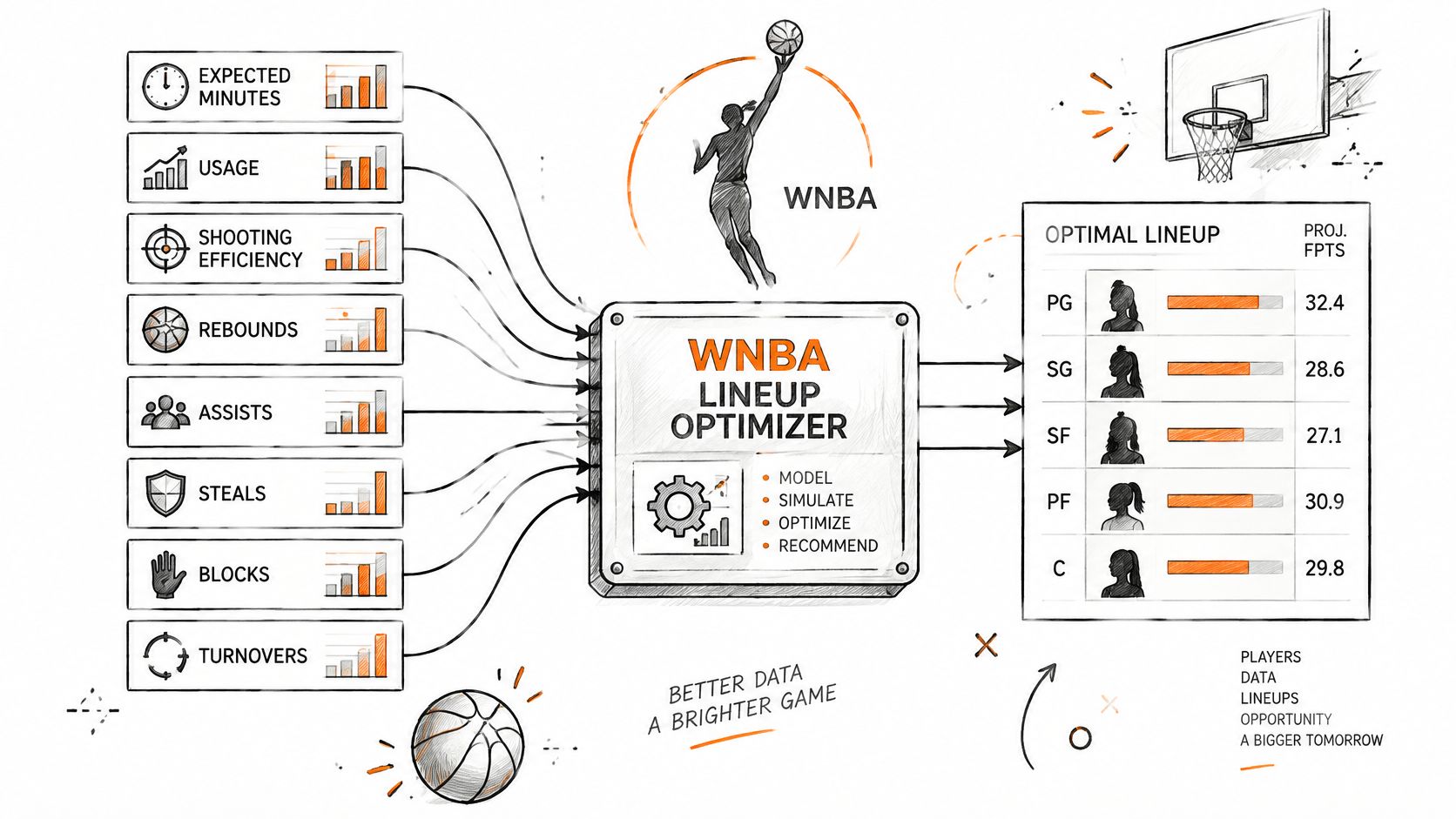
Run one test before you trust the feed. Change a single projection by a meaningful amount and rebuild. If the optimized set doesn't move, that input isn't driving the decision, and editing it further is busywork. If it does move, note whether the floor, median or ceiling changed, because each one shifts the build differently.
Lineup Controls for Cash Games and Tournaments
Cash and tournament builds should not share one control panel. Cash wants a consistent floor and less variance. A GPP wants ceiling and separation from the field. The same player can be a core hold in one and a capped piece in the other.
| Control | Cash Game Setting | Tournament Setting |
|---|---|---|
| Player exposure | Higher minimums, tighter maximums | Wider ranges, room for contrarian players |
| Team stacks | Light or no stacking | Heavier stacks with bring-backs |
| Salary use | Spend close to the cap for consistency | Leave savings for leverage where useful |
| Lineup uniqueness | Usually less important | Set minimum player differences between entries |
| Ownership limits | Favor high-projection players | Cap heavily owned picks |
Exposure is the share of the portfolio that uses one player. In a 150-entry build, a 40 percent maximum on one name forces the set onto alternatives for the other 90 entries. Without that cap, the solver repeats the same top projection in most lineups, and one bad minute total sinks the portfolio together.
Stacks raise correlation on purpose. A team stack plus a bring-back from the other side pays off when pace and scoring lift several players at once. That's the tournament goal. In a cash game, the same link is concentrated risk: if the script dies, several roster spots die with it. Our optimizer sets minimum and maximum exposure per player, plus a global cap, and it supports team stacks and game stacks with bring-backs.
Salary floors force spending near the cap or leave room on purpose. Lock and exclude lists freeze the players you're sure about and remove the ones you won't use. Uniqueness makes entries differ by a set number of players so near-copies don't burn extra fees.
Set these in the DFS optimizer. If you want a separate read on who belongs in the pool before you cap anyone, start from current WNBA DFS picks and then override with your own numbers.
Change one control at a time and compare the lineup set before and after. If you move exposure, stacks, and uniqueness together, you won't know which edit did the work.
Injury News and Role Changes Inside the Model
A flat bump on every teammate is the weak response to a late scratch. Replacements don't gain the same thing from every absence. A starter who absorbs closing minutes is not the same bet as two bench players splitting a short stretch.
Model three cases instead of one nudge.
- Base case. The player is active. Keep the original minutes and the original floor and ceiling.
- Starter absorbs the role. The player is out, and the likely starter takes the minutes. Recompute usage, rebounds, assists, steals, and blocks, not just points.
- Bench split. The player is out, and two or more reserves share the time. Minutes volatility goes up, and ceilings usually come down.
Compare floor and ceiling across the three. The player whose value moves the most is often not the one with the biggest scoring bump. Extra value frequently shows up in rebounds, assists, steals, or blocks, and those categories score at different rates on DraftKings and FanDuel.
Position matters. A guard absence doesn't hand rebounding minutes to a wing who never plays that spot. A frontcourt absence doesn't create assist volume for a big who doesn't bring the ball up. Pace and schedule can change the picture too, so test the scenario against correlated outcomes rather than adding points in isolation. The DFS simulator is the place to run those candidate lineups through repeated slates.
Use only a same-day official status. Don't assume anyone is in or out because a headline sounds confident.
Update exposures only where a scenario changes expected minutes in a meaningful way. If the minutes barely move, leave the portfolio alone.
Late Swap Rules That Decide Whether Edits Work
Late swap is how you answer news after lock, and eligibility is set per player and per game. On DraftKings, in contests that offer the feature, an athlete can be added or removed until that athlete's game starts, and once the game begins the player is locked, according to DraftKings late swap guidance. Contests that don't support late swap lock every athlete when the contest starts. Verify the contest type before you plan around an edit.
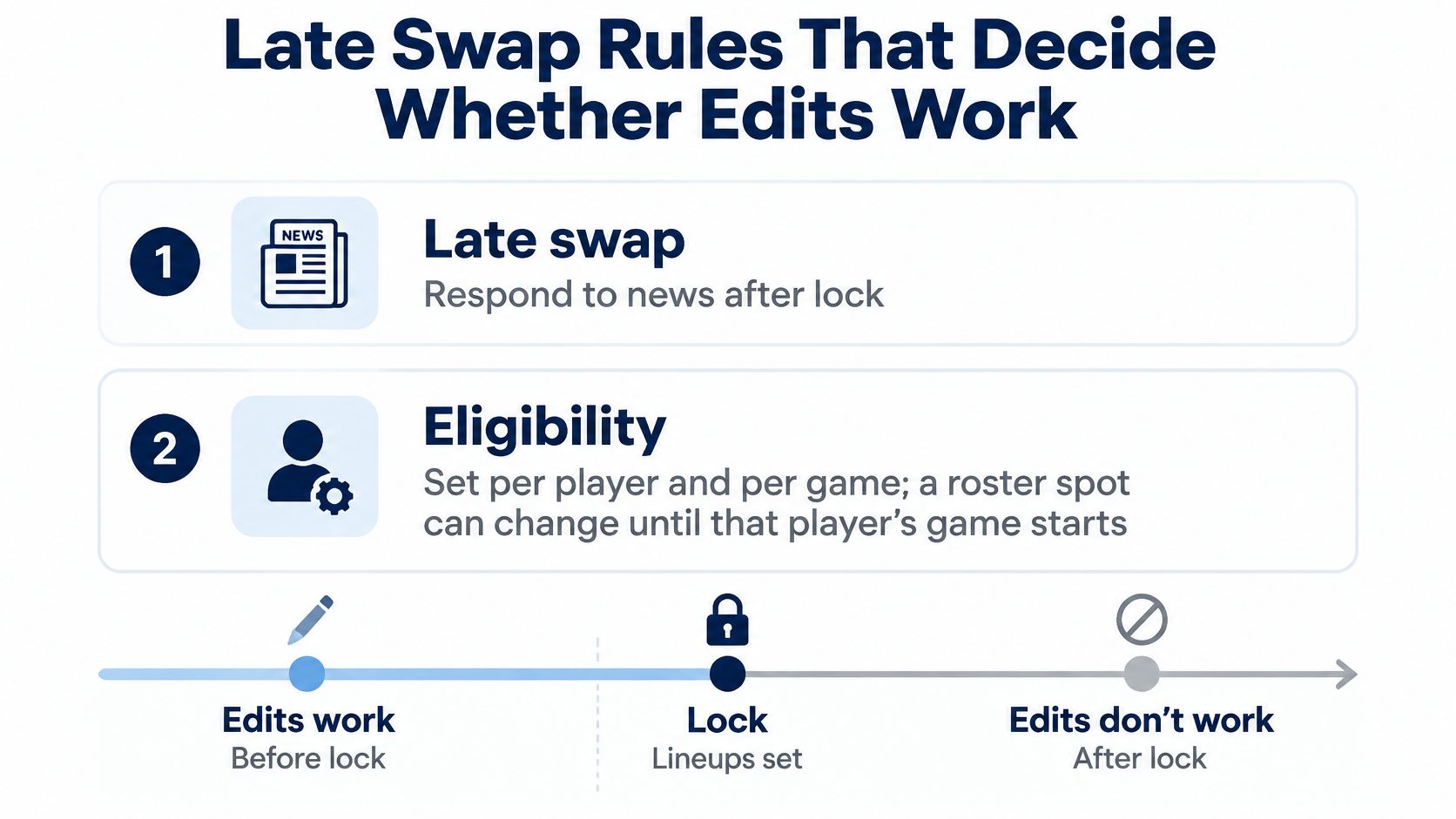
A replacement still has to satisfy salary and roster rules. The late-swap file keeps unstarted spots editable and leaves players in games that have already started exactly where they are. Late swap also re-solves those open slots across all entries after lock.
| Platform and contest | When a player can be changed | Rule to check before uploading |
|---|---|---|
| DraftKings late-swap contest | Until that athlete's game starts | Unstarted spots stay editable and locked players stay unchanged |
| DraftKings non-late-swap contest | Not after the contest starts; all athletes lock at contest start | Confirm the contest type before planning any edit |
| FanDuel late-swap contest | Until the player's scheduled game starts; no replacement after the game has started | At most four players from one team, players from at least three teams, and salary under the cap |
FanDuel keeps those roster limits active after a swap, as its contest rules describe: up to four players from one team, players from at least three teams, and no salary-cap breach. A legal-looking backup can still fail the full lineup.
Before you upload
- Confirm this contest supports late swap. DraftKings offers it only where start times are confirmed and the slate permits it.
- List locked players and their game start times.
- Mark the open slots.
- Find a replacement with enough salary room.
- Re-check team and salary rules on every entry.
- Upload before the next game starts.
A swap after a real game has begun can bring disqualification and a refund. DraftKings rules also say that if a game starts earlier than scheduled, players lock as soon as the feed shows it has begun. Trust the platform's eligibility status, not only the published tip time.
Build Your First WNBA Lineup Set Responsibly
Build the first set only after the slate type, the cap, and the roster slots match the contest you're entering. If any of those disagree with the settings, the file isn't ready.
The workflow runs in order: pick the slate, set your projections and rules, build and simulate, then export and manage. Once the build finishes, review the portfolio as a whole rather than 150 separate stories.
- Player exposure: Check each name's share against the cap you set.
- Stack share: See how many entries ride the same team or game script.
- Salary use: Look for lineups that left money idle without a reason.
- Entry spread: Confirm entries differ enough that you're not paying twice for one idea.
If late news breaks after the build, update the affected projections and rerun the solver. A rebuilt set re-applies every rule check across all entries, while a manual bump to one player can break exposures or salary elsewhere. Then export the site-compatible CSV and submit before the first game starts.
The optimizer builds up to 150 lineups per build, simulated against a modeled contest field, with exposure limits, team and game stacks with bring-backs, and a CSV in each site's upload format. Start that build in the lineup optimizer. One subscription covers all 12 sports, so the same workflow applies to every league.
Projections and simulations are estimates, no winnings are guaranteed, and lost lineups or bets are not refunded. Treat DFS as a budgeted activity, play responsibly, and only where it is legal. The notes at responsible play are the right stop if the spend is getting ahead of the plan.
StatWarrior is a lineup optimizer for DraftKings and FanDuel that turns WNBA projections, salary rules, exposure caps, and late-swap checks into upload-ready lineup sets. Simulations stay estimates, and the same subscription covers the rest of the slate work across 12 sports. Visit StatWarrior when you're ready to build the next set with the rules in place before lock.