Week 14 Fantasy Football Pickups: Six Targets for 2026
Week 14 Fantasy Football Pickups ranked by role, matchup and roster priority, with DFS notes on floor, ceiling and ownership. Estimates, not guarantees.
The waiver board looks different in December. By the time you sit down to file claims, a starter is in a walking boot, a backup has logged three straight weeks of heavy snaps, and two teams are off entirely. The managers who handle this stretch well skip the loudest headline. They ask one question first: is this role real, or is it a one-week artifact of somebody else's injury report?
That question does most of the work.
Week 14 has held the same late-season slot in the NFL calendar since the 1931 schedule through today, but the player pool underneath it turns over every single year. That's the filter for these week 14 fantasy football pickups.
What follows is six names, each run through three checks at once: the role is real, the matchup supports it, and the pickup earns its spot in your roster priority order. The ranking leans hardest on role, because volume survives a bad matchup more often than a good matchup creates volume. Each profile also carries DFS notes on floor, ceiling and projected ownership for DraftKings and FanDuel, so the order holds whether you're filing a season-long bid or building GPP and cash lineups.
1. Backup Running Back Promoted to Lead Workload
A Friday ruled-out tag changes a running back's job description. The backup inherits early-down carries, goal-line work and often the two-minute offense, so the first check is whether that role is real enough to outrank a soft matchup somewhere else.
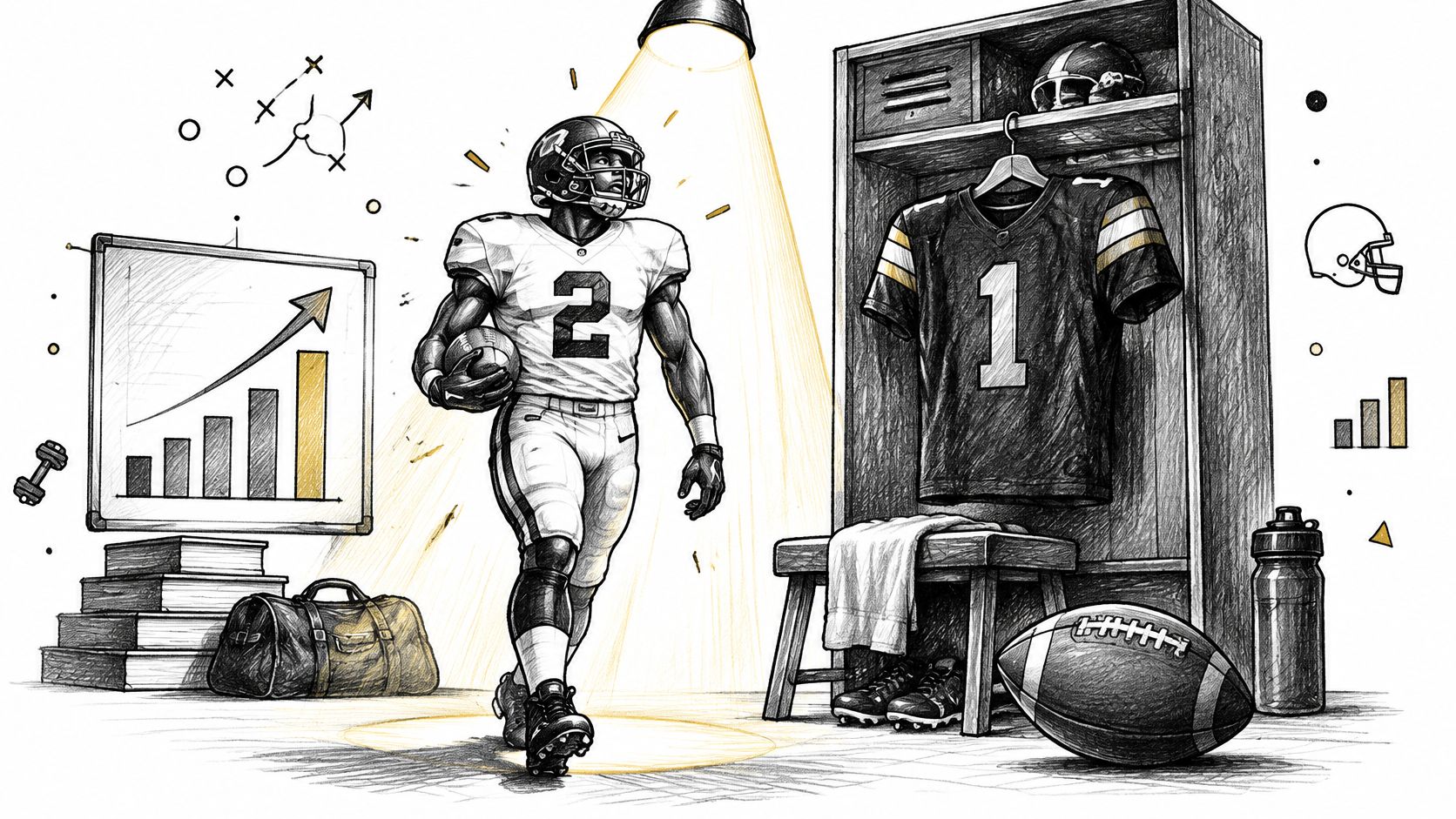
Say the starter is ruled out after practice. The backup takes most early downs, gets the carries inside the five and stays on for hurry-up drives. That is an RB2 profile while the injury holds, and it vanishes fast if the MRI clears the starter.
Read the signals in this order
- Practice report first: limited Wednesday, full Thursday, questionable Friday means you are guessing. Bid accordingly.
- Snap share, not carry totals: a back playing most snaps keeps passing-down work even when the game script turns negative.
- Red-zone role: touches inside the 10 decide whether this is a starter or a stash.
Depth charts update slowly. Beat reporters update fast. Treat anything short of an official designation as unconfirmed, and size the bid around the version of the news that hurts you most.
Practical rule: pay for the floor, not the ceiling. A guaranteed workload earns real FAAB. A possible split earns a speculative add and nothing more.
Late-season replacements are the most volatile assets on the board. DraftWaiver's Week 14 coverage has featured players like Isaac Guerendo after Jordan Mason's injury, which is exactly the shape of these pickups. The value lives in the injury timeline, not in the player's talent.
For DFS, compare floor and ceiling rather than trusting one projection; the same output is easy to scan on the NBA DFS player projections page before you apply it to Sunday. In cash games, uncertain workload caps exposure. In GPPs, it can provide an edge only if the role is confirmed, so keep an unstarted slot for late swap after news breaks.
2. Wide Receiver With a Rising Target Share
Three checks decide a Week 14 receiver claim: the role has to be real, the matchup has to support it, and the bid has to fit your roster priority. The role check comes first. A receiver's catch total swings wildly week to week, while his route participation holds far steadier, so route share is the first number to check and target share is the second.
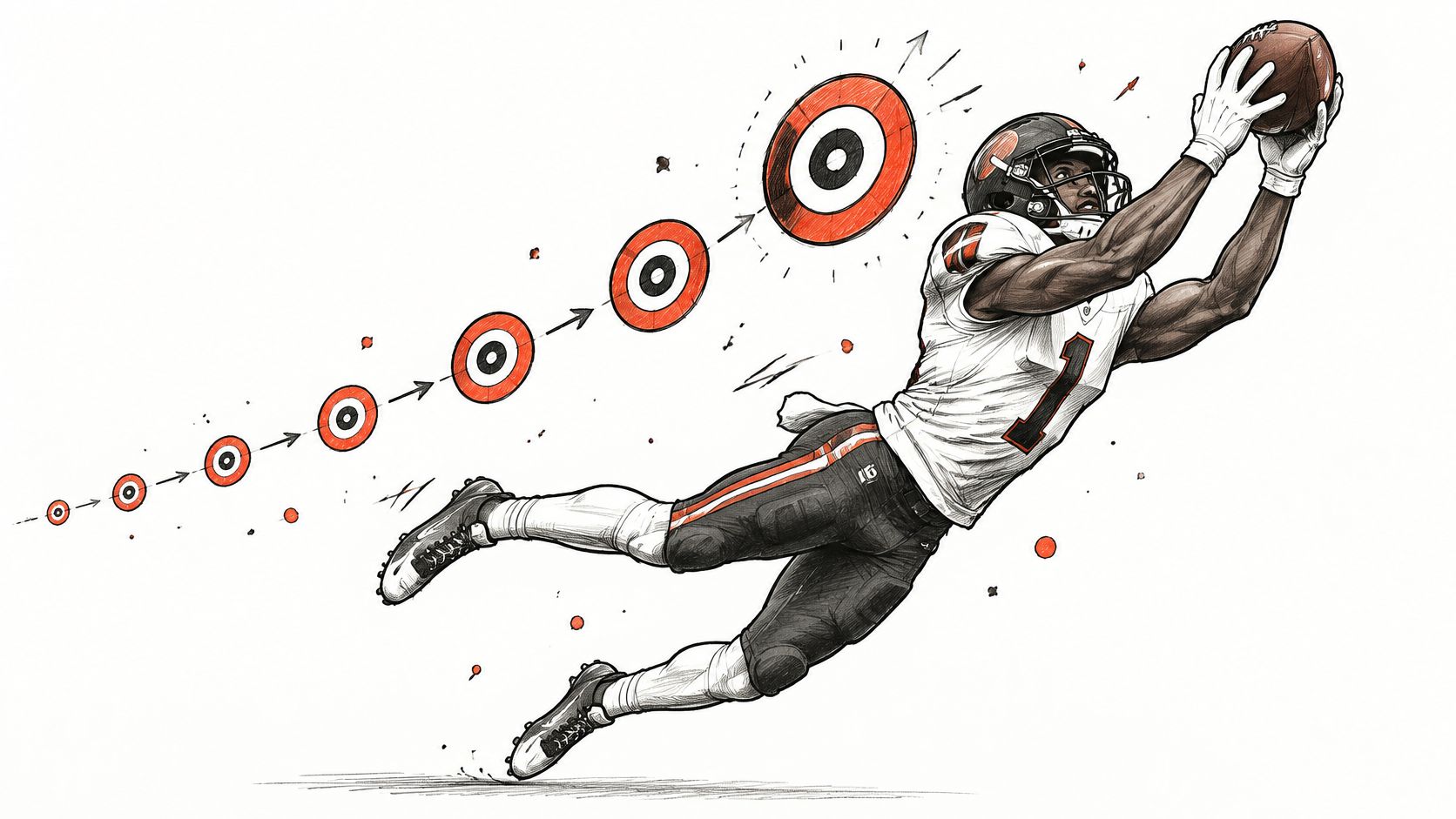
The two profiles that prompt a claim rarely look alike on the stat sheet. FantasyPros documented one recent Week 14 candidate at a 63.1% route share and 14.2% target share despite modest headline production, and another at a 67.7% route share, 30% target share, 51.3% air-yard share, 1.81 yards per route run and a 38.9% first-read share (FantasyPros). The first is a warm body absorbing snaps. The second is becoming the quarterback's first read.
Where the trap sits
A single 100-yard game on four targets is noise. A 20% target share across two or three games is a trend you can project. The middle ground, one big week with a low route share, is the claim that burns your FAAB budget in a week when three other managers are also bidding.
The matchup decides how much of that share survives game day. A corner who brackets the first read can shrink a 38.9% first-read share overnight, while a defense that funnels targets underneath protects it. The projection that matters is whether the quarterback keeps looking his way.
Priority comes last. In season-long leagues, a rising-share receiver sits behind any locked-in workload on your claim list and ahead of the touchdown-dependent flex plays. He's a real bid, sized to the share you believe.
The check: below roughly 70% route participation, you're buying targets rather than playing time, and your real wager is the quarterback and the game script.
In GPPs, a rising receiver with modest projected ownership gives you an edge over the popular names on the slate. Stack his floor, median, ceiling and projected ownership against the chalk, then classify him as a cash-game floor play or a tournament swing. The projection-first logic works on any slate, which is the approach in this NBA player comparison example.
3. Pass-Catching Running Back for PPR Formats
Rushing efficiency swings week to week. Reception volume is steadier. A back who stays on the field for third downs holds a usable PPR floor even at three yards a carry, and these backs tend to get passed over on waiver wires while managers spend on touchdown-dependent names.
The utilization picture splits them cleanly. Fantasy Life's Week 14 utilization report flagged an injury-driven replacement holding a 79% route share and 19% target share, while another candidate reached season highs of 33% snaps, 28% rushing-attempt share and 23% routes (Fantasy Life). The first supports a reception-based floor. The second needs a projected jump in carries before he's startable.
Format changes the answer
The same player can be a flex in one league and unrosterable in another. Check three things before you bid:
- Scoring format: half-PPR cuts the edge roughly in half. Standard scoring erases it.
- Depth chart above him: a passing-down back loses his role the moment the starter returns healthy.
- Team context: trailing teams abandon the run but throw more late, which can push extra targets to the back. The bigger risk is an early lead draining his routes.
On roster priority, I rank an established receiving back behind a true lead-workload promotion and ahead of pure stashes, because the role is already scoring rather than waiting on an injury. For DFS, run scenarios for both outcomes on the starter's status, and lock or exclude players across the build so one injury assumption doesn't ride through every lineup.
A modest rushing line with six catches is a starter in PPR. The same line without the catches is a bench stash.
4. Tight End Streamer Against Vulnerable Defenses
Tight end is the position where streaming works, because the gap between the fifth-best option and the twentieth is smaller than most managers think. Once your starter is on bye or banged up, chasing a name costs you flexibility you'll want back in two weeks.
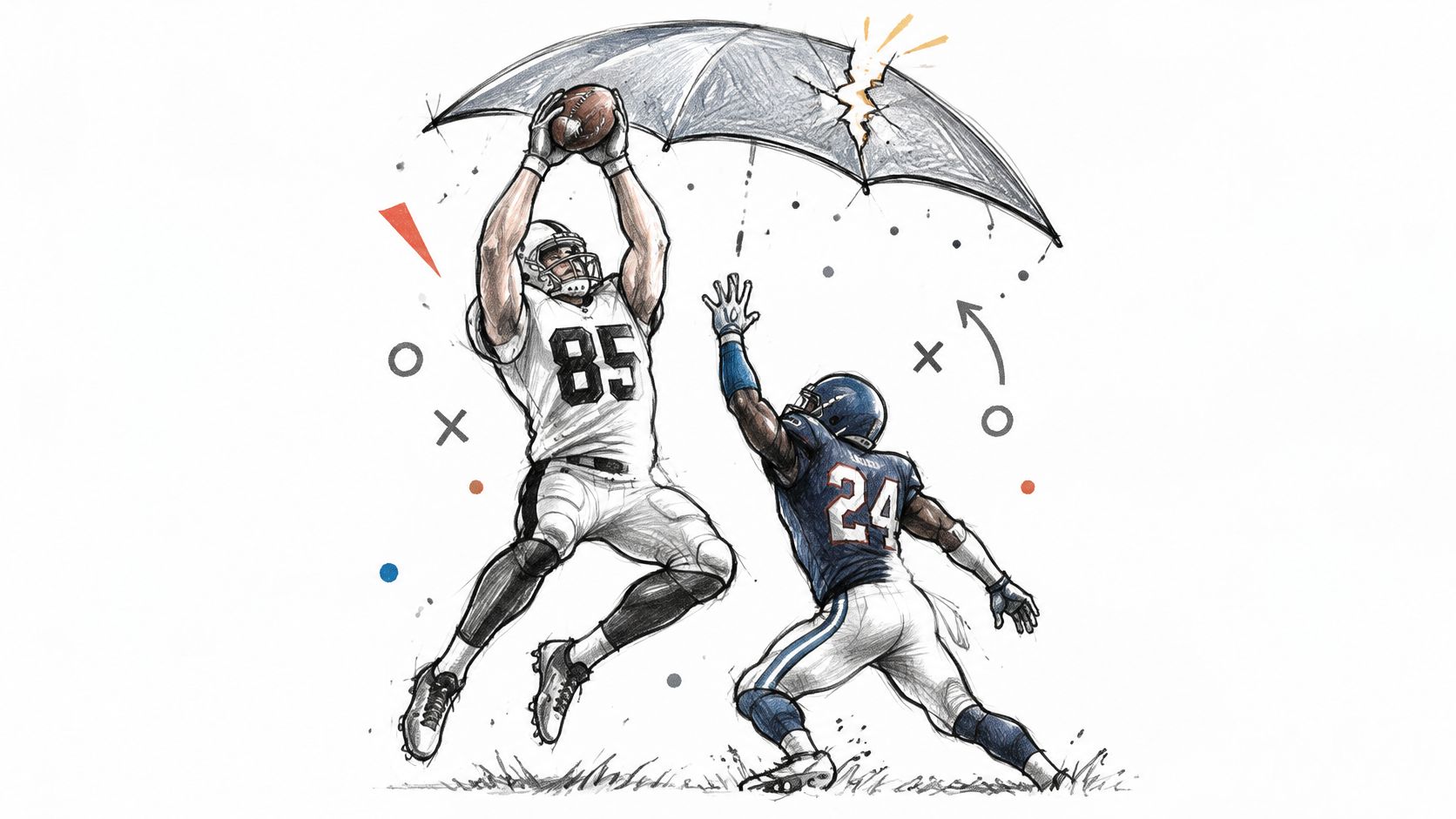
Availability is the practical bottleneck. Sporting News listed Brenton Strange as 32% rostered in Yahoo Fantasy leagues with a recommended FAAB bid of 15% (Sporting News). In a 10-team league that percentage usually means he's available. In a 14-team league with deep benches, he isn't, and the discussion is over before it starts.
Matchup, then targets, then name
Targets and red-zone involvement predict tight end scoring better than reputation does. A secondary option running routes on 70% of dropbacks against a defense that has struggled with the position all year will outscore a bigger name in a bad spot. The matchup analysis guide walks through how to weight opponent tendencies against target volume.
Use the player props tool to compare a posted reception or yardage line with the projected distribution. If your model likes the matchup more than the market does, that gap is information. If it doesn't, you've saved yourself a claim.
Cash versus GPP: in cash games, take the tight end with the safest target floor. In tournaments, take the cheaper one with the higher ceiling and lower ownership, then stack him with his quarterback when the game total supports it.
Team context matters more than raw talent here. Check the implied team total before you project a tight end, because a low total caps everyone in the passing game regardless of the matchup.
5. Quarterback Streamer Against a Weak Pass Defense
Quarterback streaming is the highest-variance habit in fantasy football. The managers who do it well treat it as a matchup rental rather than a season-long commitment, and they accept that a few of their streamer starts will cost them a week.
Timing drives the decision. Check when your league's playoffs begin, because once the bracket is set the question shifts from "who helps me most over six weeks" to "who helps me this Sunday." That changes how you spend. A quarterback you'd never roster in September becomes a reasonable one-week rental when the alternative is starting a benched veteran in an elimination game.
Volume or efficiency
Two streamers with identical projections can be built on entirely different foundations. A quarterback throwing 42 times in a trailing game script has a volume floor. A quarterback throwing 26 times with two deep touchdowns has an efficiency ceiling and no floor at all.
- Volume streamers protect you in cash games, where a 240-yard, two-touchdown line is fine.
- Efficiency streamers win GPPs, where you need the 4-touchdown outlier nobody rostered.
- Matchup quality decides which type you can afford. A weak pass defense lifts the efficiency streamer's ceiling; a shootout script lifts the volume streamer's floor.
Run the three checks in order. The role is real if he's starting and throwing, not managing blowouts. The matchup supports it if the opponent bleeds passing yards rather than just losing games. Roster priority decides the spend, because a streamer is a one-week asset and shouldn't cost like a rest-of-season piece.
The DFS simulator shows how game script changes a quarterback's range of outcomes rather than just his median, and pairing him with one or two receivers from the same offense models correlated scoring instead of independent bets.
Late swap matters here. On DraftKings and FanDuel, athletes lock at their own game's start time, and only players in games that haven't begun stay editable (DraftKings support). A streamer whose status you're unsure about belongs in the later window.
6. Defense and Special Teams Streamer
Defense is the most matchup-dependent slot in your lineup, and it's also the cheapest to rent. A unit that looks ordinary can post a top-five week against an offense that takes sacks and turns the ball over, and the same unit can lose you a matchup the following Sunday against a team that protects the quarterback.
The 2026 Week 14 schedule runs from Thursday, December 10 through Monday, December 14, with Arizona and Dallas listed on bye (Fox Sports). A four-day window means injury news can break after you've already set a Thursday lineup. Check the bye teams before you finalize anything, then check them again.
Read three rates together
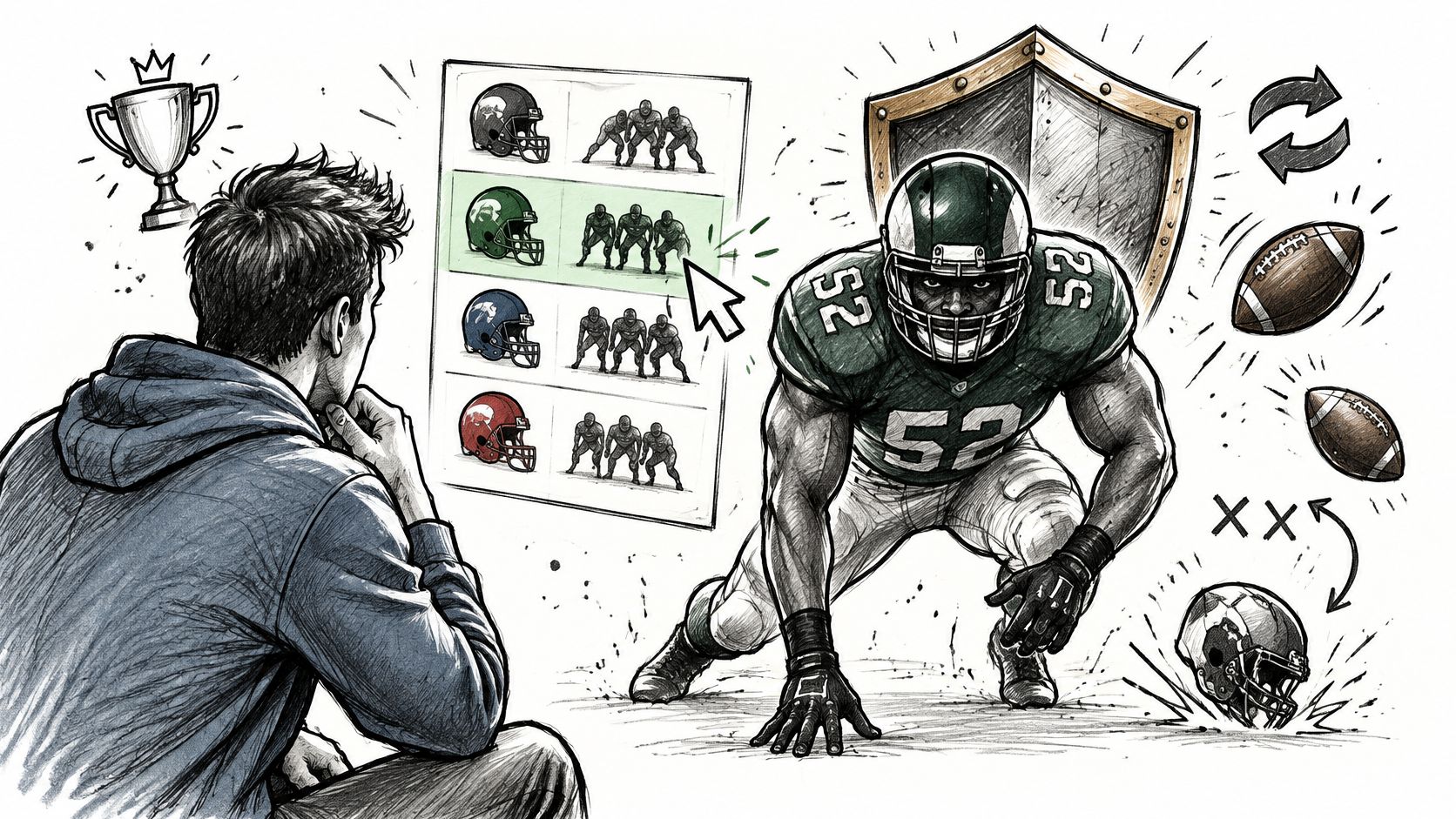
Sack rate, turnover rate and points allowed move together or not at all. A defense with a strong sack rate facing a quarterback who holds the ball invites a spike week. A defense allowing five yards a carry and relying on interceptions is a coin flip dressed up as a projection.
Practical rule: stream against pressure-prone offenses, not against bad teams. Bad teams with a mobile quarterback who gets the ball out fast will still move the chains.
Where defensive scoring is a tiebreaker in your league, a two-point edge from a streamed unit decides matchups. Treat the slot as a weekly rental rather than a season-long hold, and don't spend a top waiver priority to lock one down.
How the six Week 14 pickups compare by format, risk and roster priority
| Item | Best Format | Primary Risk | Ownership Angle | Roster Priority |
|---|---|---|---|---|
| Backup Running Back Promoted to Lead Workload | Season-long waivers and DFS | Workload may be temporary or shared | Often low waiver ownership | High if the role is confirmed |
| Wide Receiver With a Rising Target Share | PPR leagues and DFS | Small samples or a returning teammate can reduce the role | Ownership may lag the target increase | Medium to high after the trend holds |
| Pass-Catching Running Back for PPR Formats | PPR and half-PPR | Limited touchdown upside | Often overlooked due to modest rushing stats | Medium in PPR; lower in standard |
| Tight End Streamer Against Vulnerable Defenses | Weekly streaming and DFS | High weekly variance and touchdown dependence | Often low DFS ownership | Low; prioritize for a favorable matchup |
| Quarterback Streamer Against a Weak Pass Defense | Weekly streaming and DFS | Turnovers and game script can limit production | Often available on waivers | Medium when matchup and team total are favorable |
| Defense and Special Teams Streamer | Weekly streaming and DFS | Volatile scoring and dependence on opponent mistakes | Often low DFS ownership | Low; prioritize favorable matchups |
Turn Week 14 Waiver Research Into a Repeatable Routine
Every pickup above answers the same three questions. Is the role real, does the matchup support it, and does it fill the most urgent hole on your roster? If you can't answer all three with something you can point to, the player is a speculative add, not a priority claim.
Start with projections that show a floor and a ceiling rather than a single number, using the DFS projections tool. Then test how much of each player you want to roster with the DFS optimizer, which enforces salary, roster, stacking and exposure rules so one injury assumption doesn't dominate every entry. From there, run the DFS simulator to see how game script shifts outcomes across a slate, and check prop-level context in the player props tool or the broader sports betting analytics when you want market comparisons.
StatWarrior is the recommended option for this workflow. It's an independent platform, not affiliated with or endorsed by DraftKings or FanDuel, and one subscription covers all 12 sports. Every projection, simulation and ownership estimate is an estimate, not a guarantee of winnings. Play responsibly and only where it is legal, and read the responsible play guidance before you act on any of it.
The managers who win these weeks aren't the ones with the longest waiver list. They're the ones who know which of the six roles above is real, which matchup is doing the work, and which roster spot they need to fill.
Waiver decisions in Week 14 come down to role, matchup and need, and StatWarrior gives you the tools to test all three on the same slate. Projections with floor, median, ceiling and projected ownership, a late swap workflow that preserves locked players, and prop comparisons against eight sportsbooks all sit inside one subscription across 12 sports, so you're not stitching together four separate tools on a Tuesday night. Build your first lineup at StatWarrior and see how the numbers shift when the injury news lands.