Stacking Fantasy Football: How Correlated Lineups Work
Learn how stacking fantasy football pairs quarterbacks with receivers, what correlation means, and when stacks help or hurt your DFS lineups.
You're staring at a Sunday main slate with one quarterback who fits and a receiver on the same team whose salary also fits. The story writes itself. Then you remember last week, when that pairing combined for a quiet afternoon while the running back and a defense you didn't roster took the game over.
That's the decision inside stacking fantasy football. You're not hunting free points. You're choosing whether two or three roster spots should rise and fall together. On DraftKings and FanDuel, that choice changes your ceiling and your floor. Projections, simulations, and picks are estimates, not promises, and you should play only where daily fantasy and sports betting are legal.
Common Stack Types at a Glance
Stacking means rostering two or more players from the same NFL team so their fantasy points rise and fall together. Correlation is the strength of that shared movement. A strong link means a good passing day tends to lift both names. A weak link means same-team labels don't do the work for you.
A GPP is a guaranteed prize pool tournament with top-heavy payouts, so a few huge scores take most of the money. A cash game pays a much flatter share of the field, so a steady floor matters more than a rare spike. A bring-back is an opponent whose production can rise in the same game, usually a pass catcher on the other sideline.
| Stack | Players | Shared-outcome strength | Best contest fit |
|---|---|---|---|
| Skinny stack | QB + WR1, same team | Strongest measured link | Cash games and GPPs as a base |
| QB + tight end | QB + TE, same team | Moderate link | Secondary GPP option |
| Full game stack | QB + WR1 + opponent pass catcher | Strong, with game-level upside | Large-field GPPs |
| QB + running back | QB + RB, same team | No measured shared-outcome link | Not a correlated stack |
Skinny stack: Quarterback plus his leading receiver is the most defensible base. Shared targets and touchdowns can lift both spots, and the structure still works as a starting point in cash or tournaments.
Quarterback plus tight end: The link is real but softer. Use it when the tight end is the clear second option in the passing game, mostly as a secondary GPP build rather than your default.
Full game stack: You add one opponent pass catcher as a bring-back. Large-field GPPs are the home for this, because one high-scoring game can push three spots at once and you accept a lower floor to get there.
Quarterback plus running back: Treat this as roster construction, not correlation. A team that wins on the ground can feed the back and leave the quarterback ordinary.
Match the stack to the contest before you build a single lineup.
How Scoring Rules Link Quarterbacks and Receivers
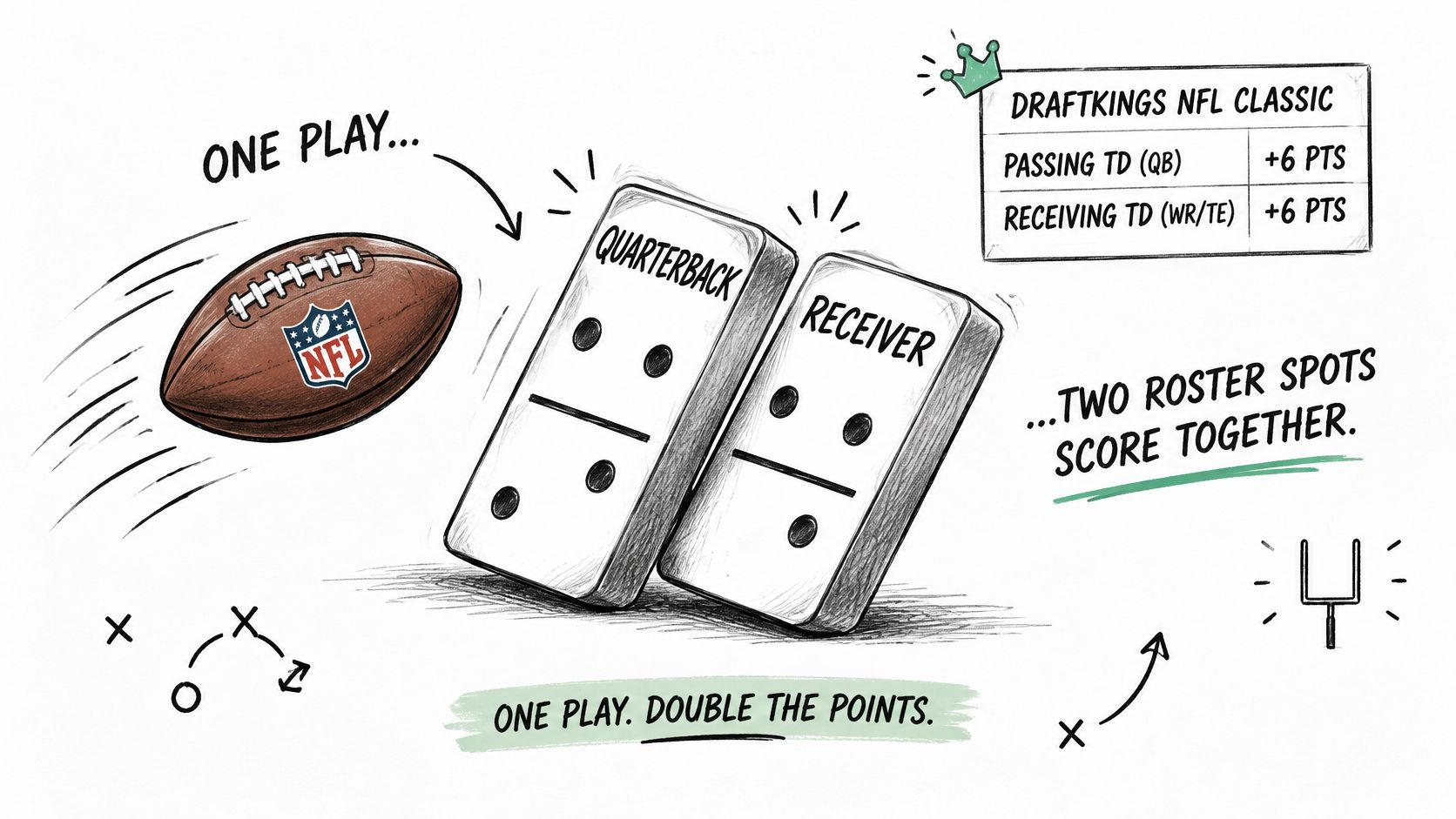
Think of one completed pass as a domino. It tips, and points fall into two roster spots from the same play.
Say your quarterback hits his top receiver on a 12-yard slant, then finds him again in the end zone two plays later. The completion adds passing yards for the quarterback and receiving yards plus a catch for the receiver. The touchdown pays both of them, on different point scales. Nothing mystical happened. The scoring rules paid the same drive twice.
What DraftKings actually pays
DraftKings NFL Classic rules set the link in plain numbers. A passing touchdown is worth 4 points to the quarterback, while a receiving touchdown is worth 6 points to the receiver. Passing yards pay 1 point per 25 yards. Receiving pays 1 point per 10 yards plus 1 point per reception.
That is why a productive passing game lifts a quarterback and his main target together. The same completion writes points on both lines. In GPPs, the point of the stack is to capture one concentrated game, not to sprinkle unrelated names across the slate.
When the quarterback runs instead
Rushing changes the picture. A rushing touchdown is worth 6 points, and rushing yards pay 1 point per 10 yards, so a dual-threat quarterback can score through a second channel. In a game where he keeps the ball near the goal line, his ceiling can rise while his receivers wait. The stack didn't break. The points took a different path.
DraftKings also pays a 3-point bonus for 300 passing yards and a 3-point bonus for 100 receiving or rushing yards. Volume and game script decide whether those bonuses are even in play. A modest lead that stays competitive tends to keep passes coming. A blowout that turns into a run game does the opposite.
Practical rule: These are scoring mechanics, not forecasts. Projections and simulations stay estimates of a range, not a script for Sunday.
Measuring How Closely Teammates Score Together
A coefficient of determination, written as r², tells you how much of one player's fantasy output moved with the other's in a past sample. An r² of 0.43 means about 43% of the variation in the receiver's output was associated with the quarterback's output. It is not a prediction that next week will split the same way.
A 4for4 analysis of PPR results from Weeks 1–16 in the 2019 and 2020 seasons grouped pass catchers by target share and measured that link.
| Pairing | r² | What it means for stacking |
|---|---|---|
| Quarterback + WR1 | 0.43 | Strongest link; basis of the skinny stack |
| Quarterback + tight end | 0.26 | Meaningful but weaker |
| Quarterback + WR2 | 0.15 | Weak; stack only with a specific reason |
| Quarterback + WR3 | 0.03 | Little shared outcome |
| Quarterback + running back | 0.00 | No measured link |
How to read the drop-off
The quarterback–WR1 pair is the strongest result in that sample, which is why the skinny stack is the basic structure worth defending. The tight end reading, 0.26, is weaker but still meaningful when that player is a real part of the passing plan. WR2 at 0.15 is thin. Stack it only when you have a concrete role, such as a concentrated red-zone share, not because the player wears the same jersey. WR3 at 0.03 and running back at 0.00 show almost no shared outcome.
The same analysis found wide receivers accounted for 58.9% of team targets over those two seasons. Shared passing volume is why the primary catcher moves with the quarterback. A back who gets his points on the ground doesn't share that channel.
What the sample does not say
This is one analysis, two seasons, and PPR scoring. It describes a pattern. It is not a rule for every week, every offense, or a half-PPR slate. A receiver has to be involved often enough for the quarterback's passes to reach him. Target share, expected targets, and red-zone usage tell you more than team membership.
Rank candidate teammates by that shared-outcome strength before you add anyone. If the best link on the team is a low-volume third option, skip the stack and take the quarterback alone.
Weighing Ceiling Gains Against Floor Losses
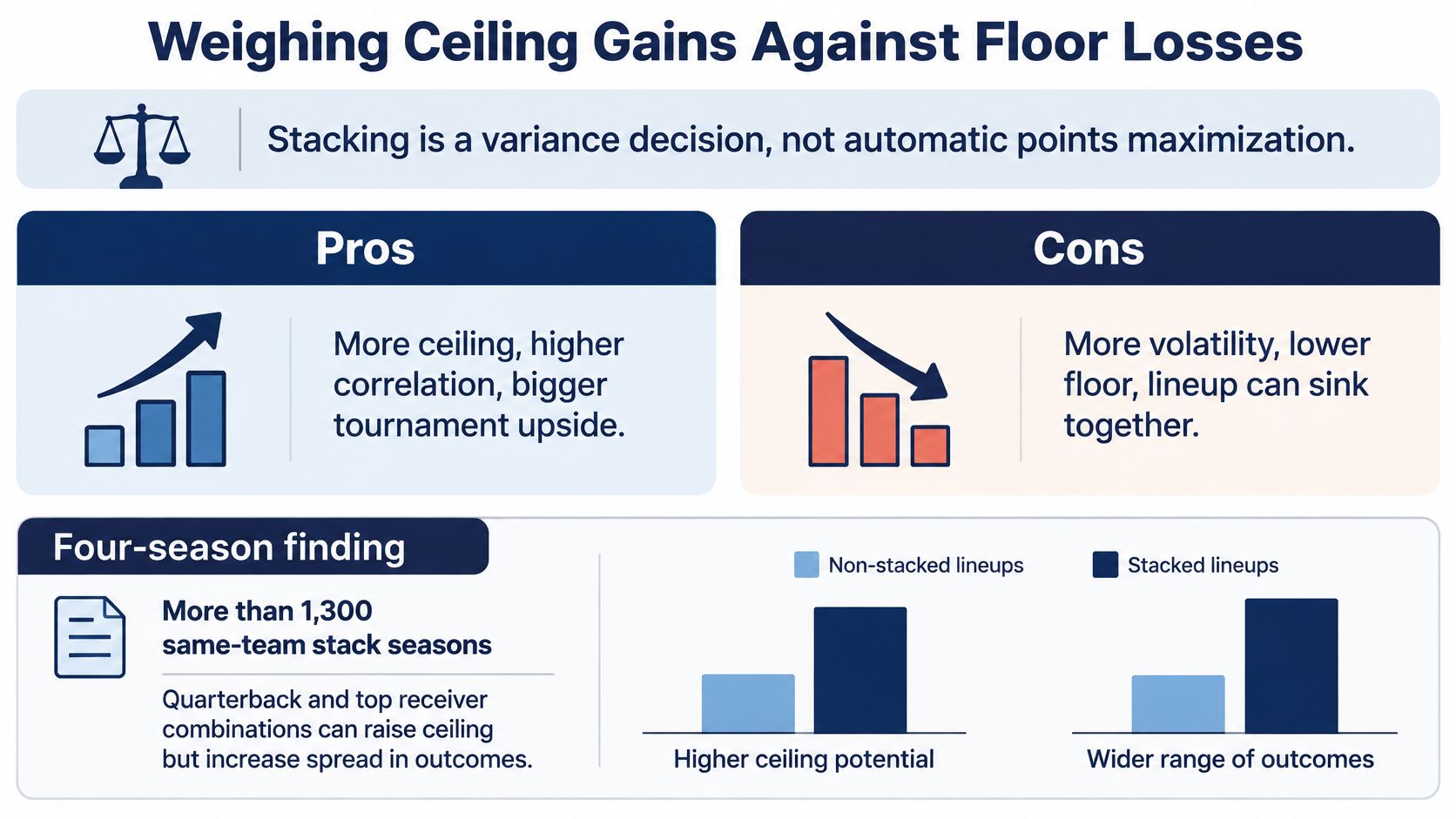
Stacking is a variance decision, not automatic points maximization. A quarterback and his top receiver can post a strong combined week and still be a poor choice for the contest you're entering.
A RotoWire review of more than 1,300 same-team stack seasons across four seasons found a quarterback and his top wide receiver had only a +0.31 weekly correlation. Quarterback–running back correlation was +0.07. Same-team wide receiver pairs were -0.02, meaning those teammates tended not to peak together.
The points you gain and the points you give up
In that same review, QB–WR stacks produced roughly 1.8 additional combined ceiling points and sacrificed about 1.6 floor points versus comparable uncorrelated pairings. Week-to-week boom-or-bust behavior rose by about 14%. You are trading a slightly higher joint top for a slightly worse bad week, and you are making the week swingier.
GPP players can accept that trade because top-heavy payouts pay the ceiling, not the median. Cash-game players, and many season-long managers, usually want independent high-floor pieces so one stalled drive doesn't sink two roster spots. The same floor-versus-ceiling check shows up when you sort NBA DFS player projections: a forced pairing loses to separate, sturdy options when the payout is flat.
Correlation is not causation
A shared game environment can make two players score together. It doesn't force both of them to benefit when the team succeeds. A win built on rushing, turnovers, or three different pass catchers can leave your specific pair short of the total you pictured. Ownership matters here too. A popular pairing doesn't become safer because lots of lineups chose it. It becomes less useful for separating your entry in a large field.
These figures describe past seasons. No stack guarantees a result, and a lost lineup isn't refunded, because projections and simulations are estimates.
StatWarrior provides analytics, projections, and simulations for informational purposes. Use them to compare an expected ceiling with the floor you give up, then decide whether that spread fits the contest.
Building a Game Stack Step by Step
A full game stack is three players tied to one environment: your quarterback, his primary pass catcher, and one opponent. You give up some floor for a stronger joint ceiling, which fits GPPs better than cash games.
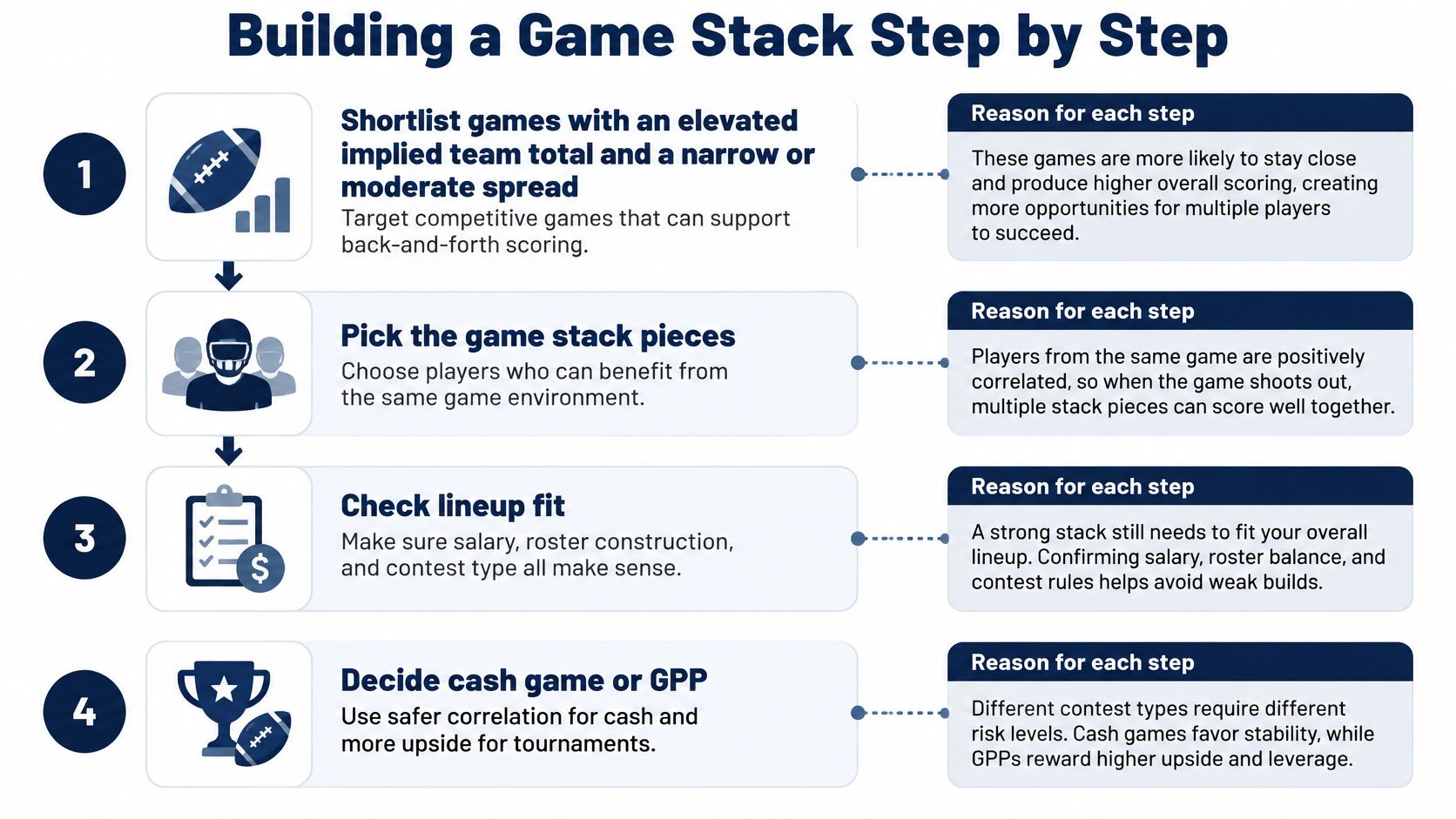
Work one game at a time. Salaries, injuries, and betting numbers move daily, so treat implied totals and spreads as inputs you refresh, not as facts you memorize.
- Shortlist the game environment. Start with a high implied team total and a narrow or moderate spread. Competitive games let both teams keep throwing. A fantasy football matchup analysis pass helps you drop games that look loud in a headline and quiet in the projected script.
- Pick the quarterback with a real WR1. You want a passer whose team has one receiver drawing a concentrated share, not a committee of four similar options. If the targets are scattered, the joint ceiling thins out even when the total is high.
- Add the primary pass catcher. Take the teammate with the highest expected targets and the clearer red-zone role. Volume is the prerequisite. A famous name on a low target share is a narrative, not a stack piece.
- Bring back one opponent. Add a single pass catcher from the other team so a shootout pays your lineup from both directions. One bring-back is enough. A second opponent usually spends salary you need elsewhere.
- Check the combined salary. Three expensive names can force punts at running back and defense. If the trio leaves you no room for a credible rest of the roster, the ceiling of the stack is theoretical.
- Compare joint ceiling with expected ownership. In large fields, ownership decides whether the stack differentiates you. Drop a popular build when the field is already on it and a slightly less obvious game offers a similar path to a winning score.
What winning lineups actually contained
An NBC Sports review of top-10 lineups from major NFL tournaments found quarterback–wide receiver combinations in 43.75% of those DraftKings lineups and 40.59% on FanDuel. A correlated opponent showed up far less often, in 7.50% and 7.06% of those lineups. The skinny piece is common at the top. The full game stack is the sharper, less crowded version, and it still isn't a requirement. Probability beats the story you prefer.
Late Swap and Lock Times for Stacked Players
A stack only stays editable for as long as each player is open for changes. Miss a kickoff and that piece of the build is frozen, score and all.
FanDuel's rules, read next to DraftKings' late-swap rules, split by site and by contest type.
| Platform | Contest setting | Lock point | Edits after lock |
|---|---|---|---|
| DraftKings | Late-swap contest | Each player locks at own team's game start | None; post-start changes can disqualify the lineup |
| FanDuel | Without late swap | Contest locks at first game of slate | Not editable |
| FanDuel | With late swap | Each player locks at scheduled game time | Editable until each player's game |
On DraftKings, a late-swap contest locks each player at the scheduled start of that player's own game. After lock, you can't add or remove that player. A lineup change made after a game's real-life start can get the lineup disqualified and refunded, so the kickoff clock is part of the strategy, not a side detail.
On FanDuel, a contest without late swap locks when the first game of the slate starts. A contest that offers late swap lets you edit until each player's scheduled game time. Read the contest card before you assume you have a window.
What that does to a stack
An early quarterback and his receiver lock together at their kickoff. You can't swap one of them for a late hammer after you've seen the first quarter. Unstarted players on the back end of the slate can still move, if the contest allows late swap.
- Reserve late spots: Leave eligible late-game roster spots for players whose status is still uncertain.
- Watch confirmed inactives: Act on official inactive news, not on a rumor thread.
- Rebuild only open slots: Keep every locked player in place and refill the unstarted positions around them.
Late swap manages information. It can't rewrite points already scored, and it doesn't guarantee a better result.
If your stack is in the early window, decide the bring-back and the rest of the roster before that kickoff. The late news only helps the spots you left open on purpose.
Test Your Stack Before You Lock Your Lineup
For this contest, pick one of three builds: a skinny stack, a full game stack, or no stack. Don't leave the choice implied inside a salary that happened to fit.
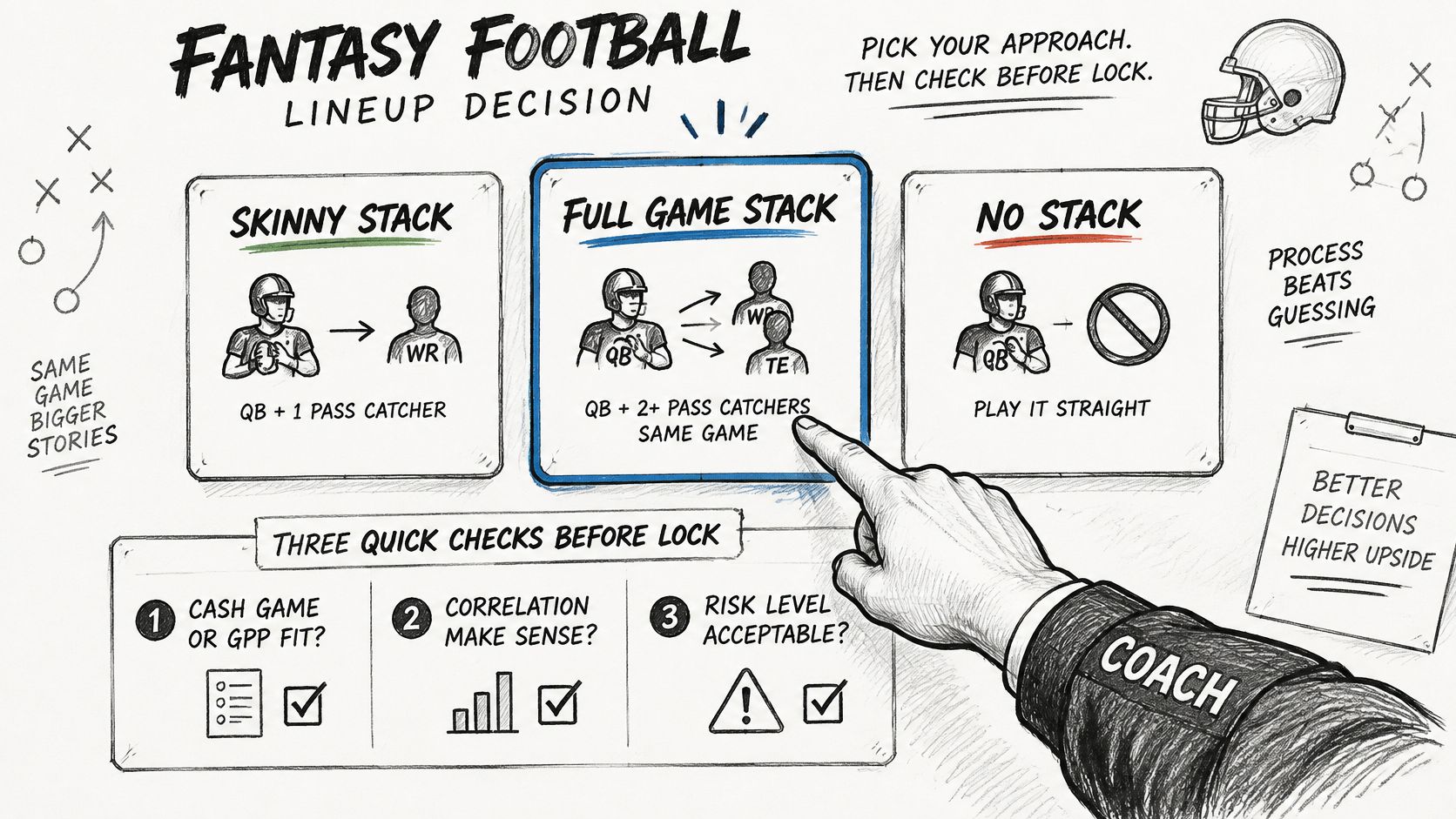
Run three checks before you lock.
Does the structure match the payout? Cash games want the calmer base, usually a skinny stack or no stack at all. Large-field GPPs are where the bring-back earns its salary, because one game can carry several spots into the paid tail.
Does the joint ceiling pay for the floor you lose? If the three names only look strong when everything breaks right, and the rest of the roster is a set of punts, the build is a lottery ticket. Price it that way.
Does the floor survive a stalled game? If the total disappoints, can the other roster spots still keep you near the cash line? If the answer is no, you're holding a single environment with no backup plan.
A simulator helps because a single projection hides that spread. Our simulation engine draws correlated outcomes for every player and scores lineups against a field built from projected ownership, so you see how often a build lands in the top slice of a modeled contest rather than trusting one median. The DFS optimizer builds DraftKings and FanDuel lineups with team stacks, bring-backs, and exposure limits, up to 150 lineups per build for large fields. Pair that with the DFS simulator, and pull the estimates behind both from DFS projections. One subscription covers all 12 sports. The same exposure idea shows up in a WNBA lineup optimizer workflow, where a cap stops one game from owning every entry you submit.
StatWarrior is independent and is not affiliated with or endorsed by DraftKings or FanDuel.
Play only where it is legal, set a limit before the slate starts, and read our notes on responsible play. Nothing in a model turns an estimate into a sure result.
Before you upload, watch a short walkthrough of how correlated builds get checked against a field, then run your own three checks on the lineup sitting in your cart.
StatWarrior gives you lineup optimization, projections, and contest simulations so you can test a skinny stack or a full game stack as an estimate, not a promise. Build the correlation into the roster rules, see how the lineup scores against a modeled field, and keep the rest of your research in the same place. Visit StatWarrior and run your next slate with the stack choice made on purpose.